Kshitij Goel Robotics Researcher

Distributed Decision-Making for Robot Teams

Decentralized coordination, active search, and mapping for robot teams operating far beyond reliable communications.
This thread studies how each robot in a team can decide for itself — where to search, what to map, and what to share — so the team stays effective in unknown, hazardous, and communication-denied environments.

When robot teams leave the lab, centralized coordination breaks down: links drop, bandwidth collapses, and no single vehicle ever sees the whole picture. Our work pushes the decision-making onto the robots themselves.

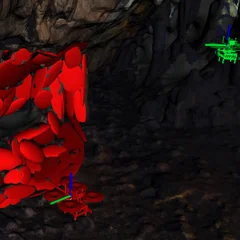
The foundation is communication-efficient perception. By modeling local occupancy as Gaussian mixtures and exchanging only a sparse set of informative views, robots share a global picture of the environment under tight bandwidth budgets. Built on this, our distributed mapping approach lets a multi-robot team rapidly explore subterranean environments at high fidelity, validated in hardware experiments in a wild cave in West Virginia.

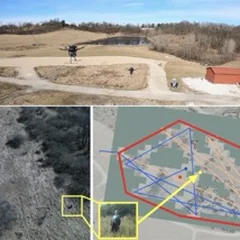
More recent work makes the coordination fully decentralized. In active search, each robot biases its trajectories toward resolving uncertainty over the locations of an a priori unknown number of targets, exploiting stochasticity for coverage when communication is denied and fusing detections across vehicles when it is available. Field experiments with a team of aerial robots outperform greedy coverage-based planning in communication-denied scenarios while localizing all targets to within a few meters.

Related publications

Work in this area

Decentralized Uncertainty-Aware Active Search with a Team of Aerial Robots

Decentralized Uncertainty-Aware Active Search with a Team of Aerial Robots

Wennie Tabib, John Stecklein, Caleb McDowell, Kshitij Goel, Felix Jonathan, Abhishek Rathod, Meghan Kokoski, Edsel Burkholder, Brian Wallace, Luis Ernesto-Navarro-Serment, Nikhil Angad Bakshi, Tejus Gupta, Norman Papernick, David Guttendorf, Erik E. Kahn, Jessica Kasemer, Jesse Holdaway, and Jeff Schneider

ISER 2025