Kshitij Goel Robotics Researcher

Rapid and High-Fidelity Subsurface Exploration with Multiple Aerial Robots

ISER · 2021

National Science Foundation (NSF) Ph.D. Student Travel Award

How to enable rapid multi-robot exploration in subsurface environments by leveraging a perceptual modeling framework amenable to low-bandwidth communication while remaining high-fidelity?

This paper develops a communication-efficient distributed mapping approach for rapid exploration of a cave by a multi-robot team. Subsurface planetary exploration is an unsolved problem challenged by communication, power, and compute constraints. Prior works have addressed the problems of rapid exploration and leveraging multiple systems to increase exploration rate; however, communication considerations have been left largely unaddressed. This paper bridges this gap in the state of the art by developing distributed perceptual modeling that enables high-fidelity mapping while remaining amenable to low-bandwidth communication channels. The approach yields significant gains in exploration rate for multi-robot teams as compared to state-of-the-art approaches. The work is evaluated through simulation studies and hardware experiments in a wild cave in West Virginia.

Figures

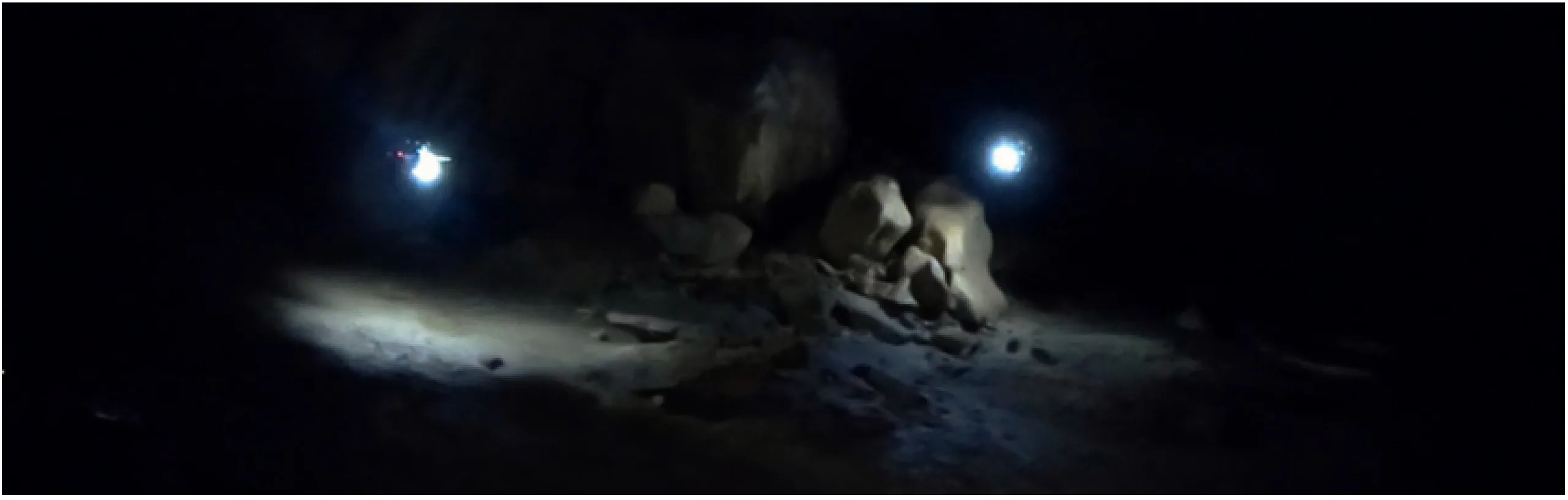
Cave Exploration Deployment
Cave Exploration Deployment Cave exploration with two aerial robots in West Virginia, USA. A video of the flight can be accessed at the following link: https://youtu.be/osko8EKKZUM.
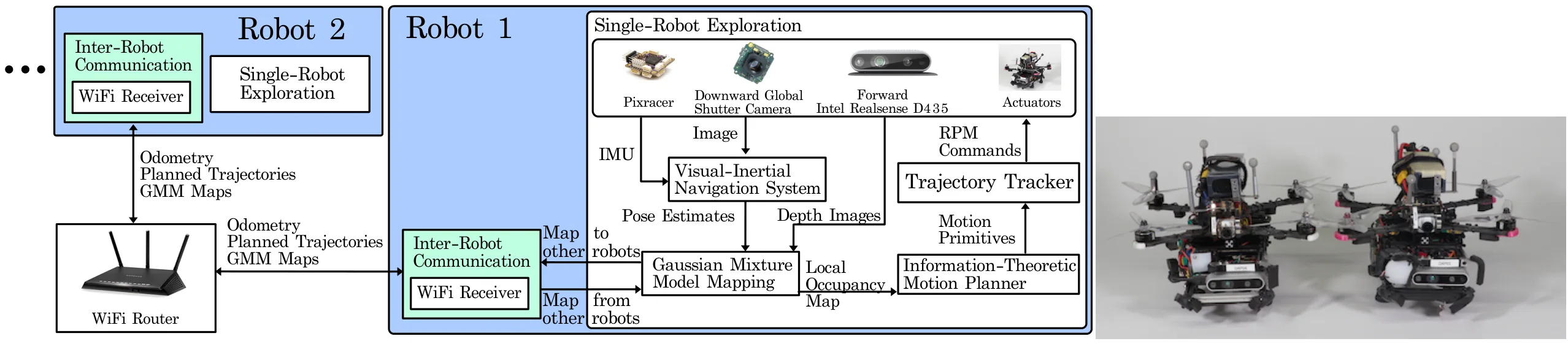
Framework Overview
Framework Overview (Left) Overview of the rapid multi-robot exploration framework and (Right) aerial systems used in experiments in this work.
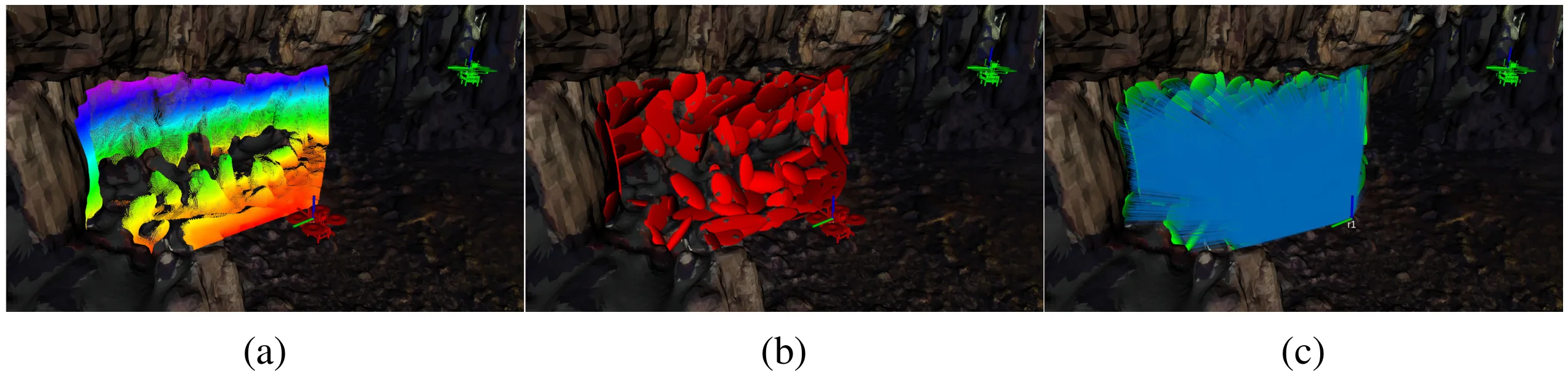
Distributed Mapping Approach
Distributed Mapping Approach Overview of the distributed mapping approach. (a) Robot i shown in red, takes a sensor observation shown in colors varying from red to purple and (b) learns a GMM (shown in red). If the GMM is determined to be a keyframe both the GMM and sensor pose are transmitted to robot
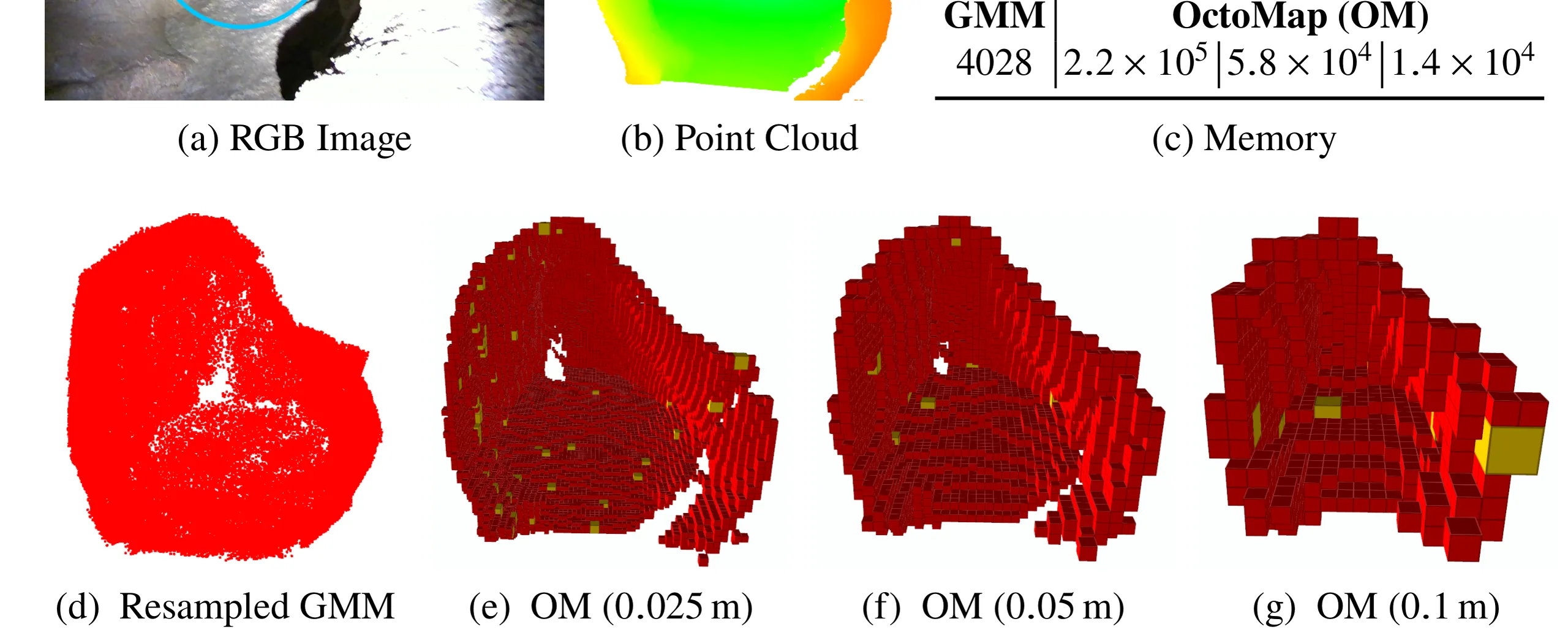
Fidelity and Memory Evaluation
Fidelity and Memory Evaluation Fidelity and memory usage evaluation of several mapping approaches. (a) and (b) illustrate data from a representative environment the robot may encounter in the cave. A potential passage is circled in cyan. (c) highlights significant reduction in memory usage required by the GMM approach as compared to the OG and OM approaches. (d) Resampled points from the GMM are shown in red. (e)–(g) illustrate the OctoMap representation with leaf sizes varying from 0.025 m to 0.1 m. Leaf voxels are shown in red and larger voxels in yellow.
Two-Robot Cave Exploration
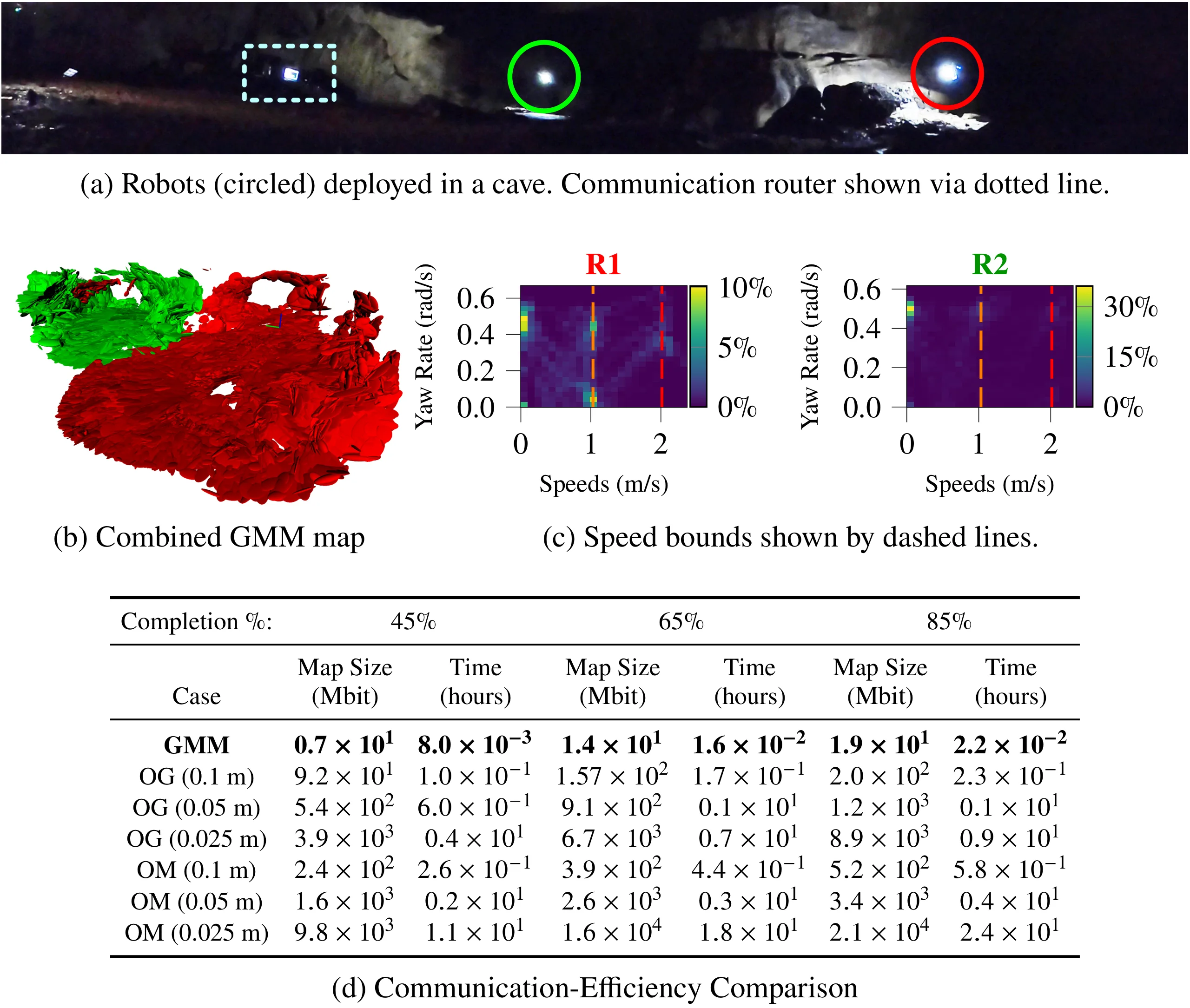
Two-Robot Cave Exploration Rapid and communication efficient exploration of a cave with a team of two aerial robots. (a) illustrates the environment with the two robots (R1 and R2) and the WiFi router used for communication. (b) illustrates the final GMM maps generated on the base-station. (c) shows the percentage density plots for linear speeds and yaw rates as measured by the visual-inertial navigation system during flight. (d) highlights that the GMM approach requires significantly less memory to represent the combined map as compared to state-of-the-art approaches. In the context of transmitting this data using a channel with capacity 0.25 Mbit/s, it would take significantly less time for the GMM approach as compared to the other approaches. A video of the flight can be accessed here: https://youtu.be/osko8EKKZUM.
Communication Limit Study
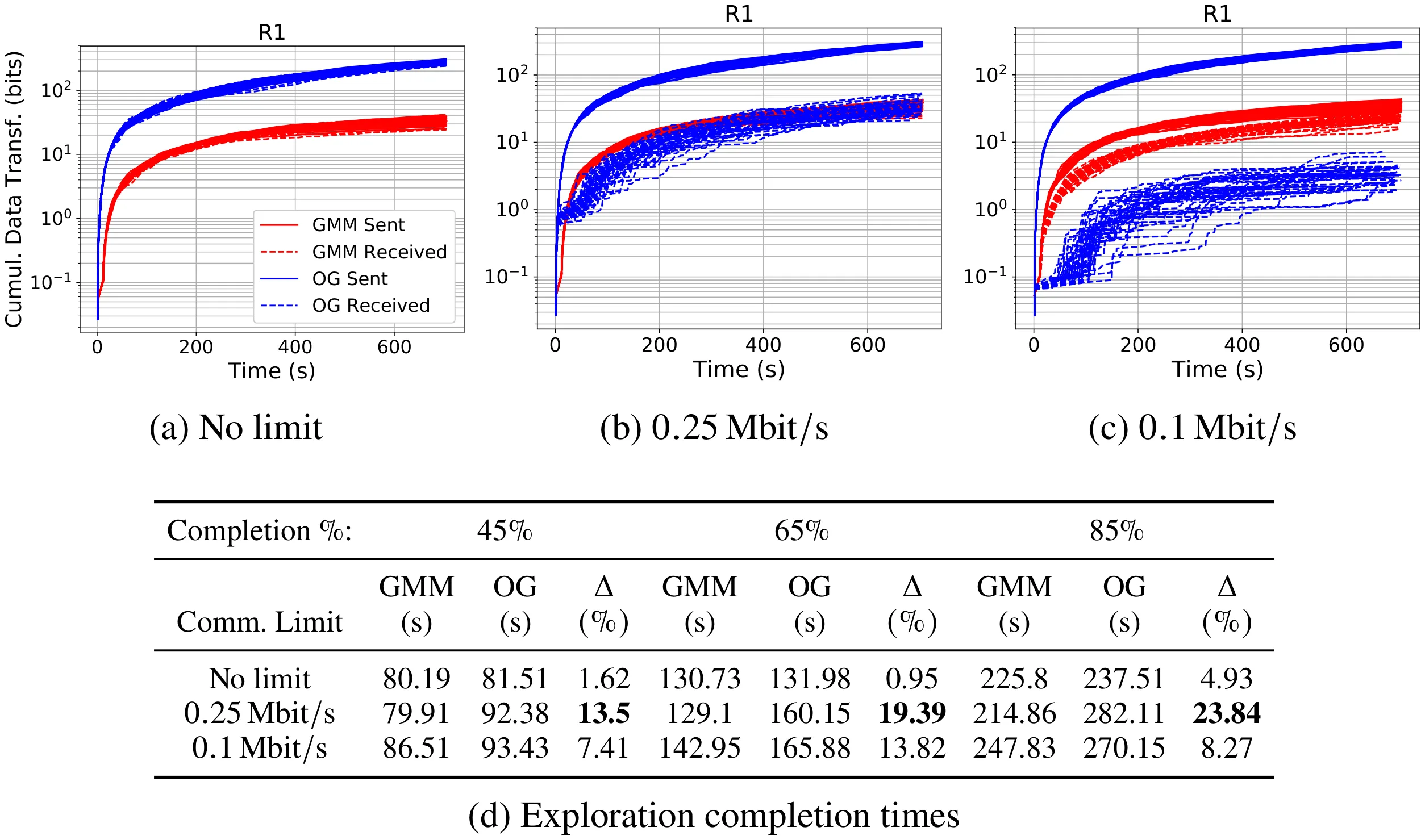
Communication Limit Study Variation of exploration performance with inter-robot communication limits. (a), (b), and (c) plot the cumulative map data sent and received for the GMM and OG approaches under different data rate constraints (the plots are shown for R1 only for brevity). The received data is impacted significantly for the OG approach at 0.25 Mbit/s while both approaches are affected at 0.1 Mbit/s. Note that in all experiments the planning and coordination methodology is kept the same for a fair comparison. (d) compares the time to achieve a certain percentage of environment coverage. We observe that at the 0.25 Mbit/s constraint, the GMM approach improves the performance of the team by up to 23.84%.

BibTeX

@inproceedings{rapid-high-fidelity-subsurface-2021,
  title={Rapid and High-Fidelity Subsurface Exploration with Multiple Aerial Robots},
  author={Kshitij Goel, Wennie Tabib, and Nathan Michael},
  booktitle={International Symposium on Experimental Robotics (ISER), 2021},
  year={2021}
}