Agile and Resilient Autonomous Flight
Planning, control, and learned policies that let aerial robots move at speed through cluttered unknown environments.
This research asks how fast a quadrotor can safely fly through a space it is seeing for the first time — using only onboard depth cameras, IMUs, and learned or reactive decision-making.
Flying fast through an unknown space stresses every layer of the autonomy stack: perception must digest depth observations in milliseconds, planners must commit to motion before the map is complete, and control must stay safe at the edge of the vehicle’s dynamics. Our work spans this spectrum, from reactive planning to end-to-end learned policies.
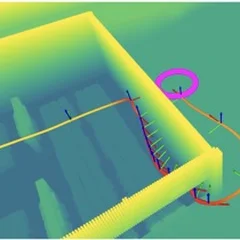
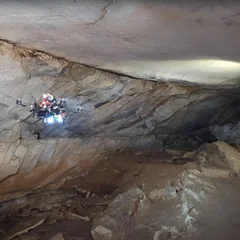
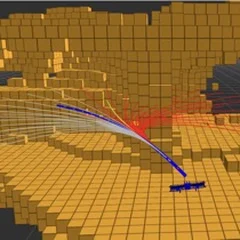
On the reactive side, we build safe motion-primitive planners that query a locally consistent map from forward-facing depth, first enabling collision-free teleoperation and autonomous flight beyond 10 m/s in GPS-denied clutter. Later work modulates maximum speed through hierarchical collision checking that adapts map resolution to environment complexity, and schedules a safe stopping action every planning round — raising navigation success rates in diverse settings such as caves and forests.
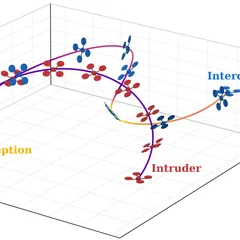
On the learning side, we train control policies in differentiable simulation. A reinforcement learning navigator uses time-of-arrival maps as privileged information and a yaw-alignment loss to route around large obstacles, flying hundreds of meters collision-free onboard; a related policy learns agile intruder interception directly from a bearing vector using analytical gradients through the quadrotor dynamics.
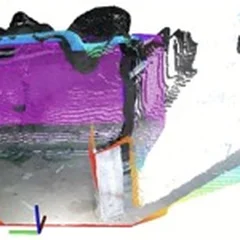
Underpinning both is lightweight onboard perception. Rather than rely on heavy LiDAR or stereo, we rescale monocular relative depth into metric depth using a visual-inertial feature map, yielding real-time depth estimates that feed the collision-avoidance planners directly.