Kshitij Goel Robotics Researcher

Fast and Agile Vision-Based Flight with Teleoperation and Collision Avoidance on a Multirotor

ISER · 2018

How to enable aggressive and collision-free semiautonomous teleoperated flight in unstructured GPS-denied environments?

We present a multirotor architecture capable of aggressive autonomous flight and collision-free teleoperation in unstructured, GPS-denied environments. The proposed system enables aggressive and safe autonomous flight around clutter by integrating recent advancements in visual-inertial state estimation and teleoperation. Our teleoperation framework maps user inputs onto smooth and dynamically feasible motion primitives. Collision-free trajectories are ensured by querying a locally consistent map that is incrementally constructed from forward-facing depth observations. Our system enables a non-expert operator to safely navigate a multirotor around obstacles at speeds of 10 m/s. We achieve autonomous flights at speeds exceeding 12 m/s and accelerations exceeding 12 m/s^2 in a series of outdoor field experiments that validate our approach.

Figures

Trajectory Generation Strategy
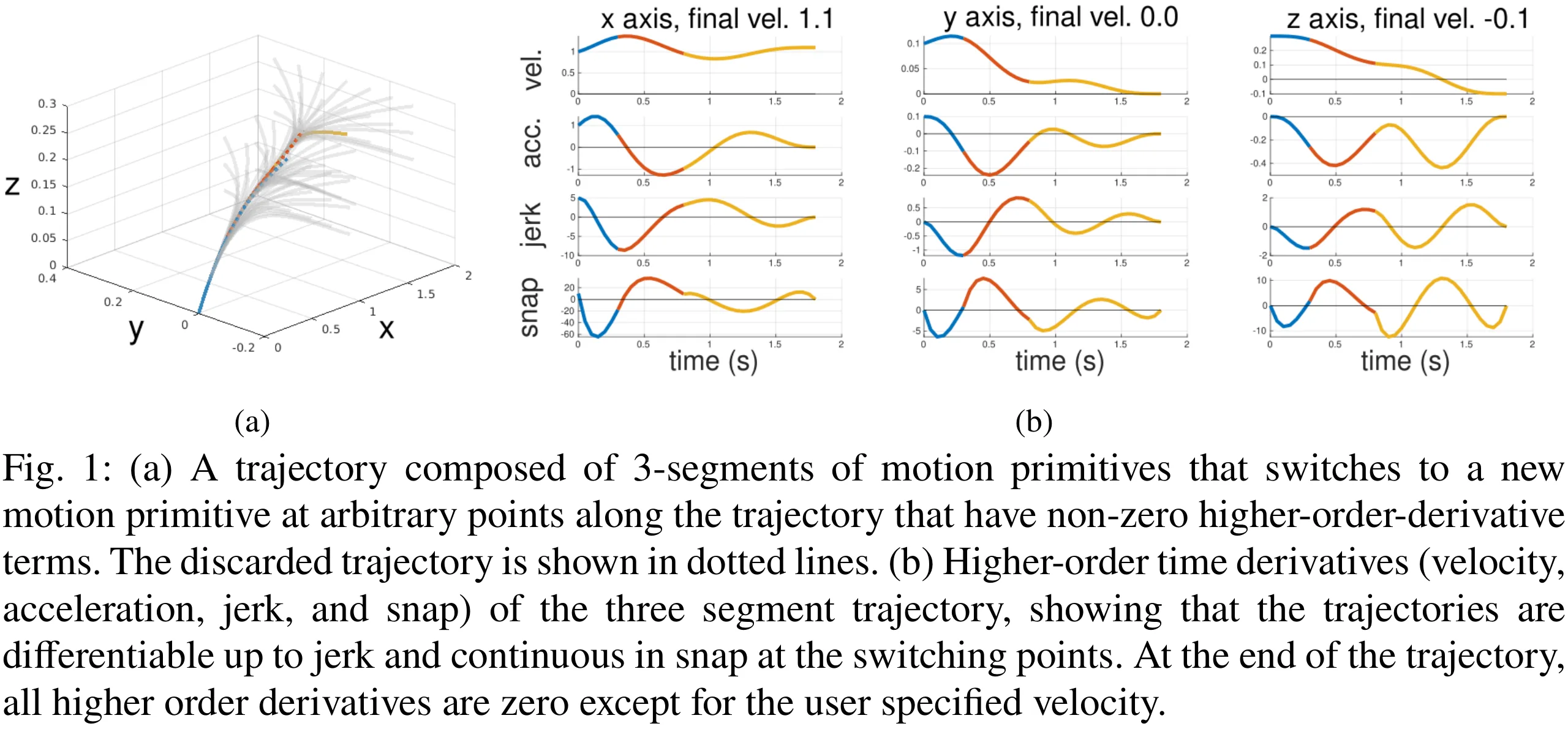
Trajectory Generation Strategy (a) A trajectory composed of 3-segments of motion primitives that switches to a new motion primitive at arbitrary points along the trajectory that have non-zero higher-order-derivative terms. The discarded trajectory is shown in dotted lines. (b) Higher-order time derivatives (velocity, acceleration, jerk, and snap) of the three segment trajectory, showing that the trajectories are differentiable up to jerk and continuous in snap at the switching points. At the end of the trajectory, all higher order derivatives are zero except for the user specified velocity.
Motion Primitive Library
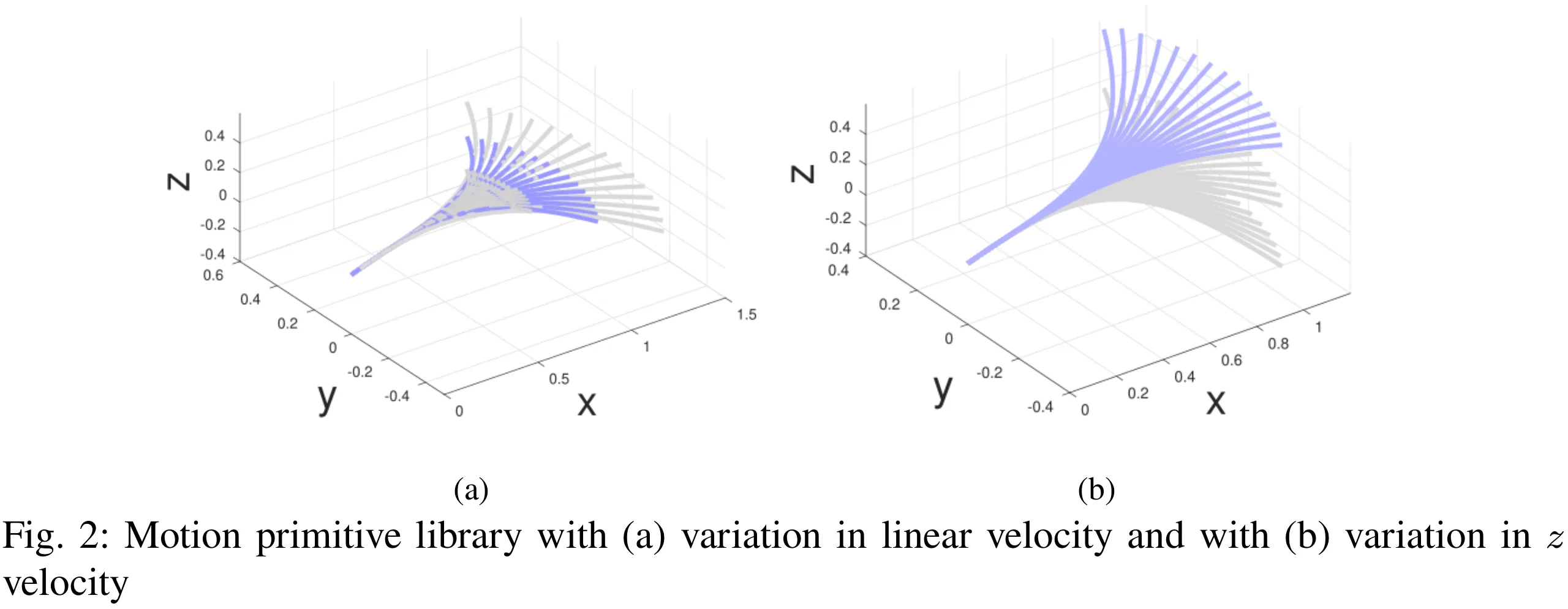
Motion Primitive Library Motion primitive library with (a) variation in linear velocity and with (b) variation in z velocity
Platform and Environments
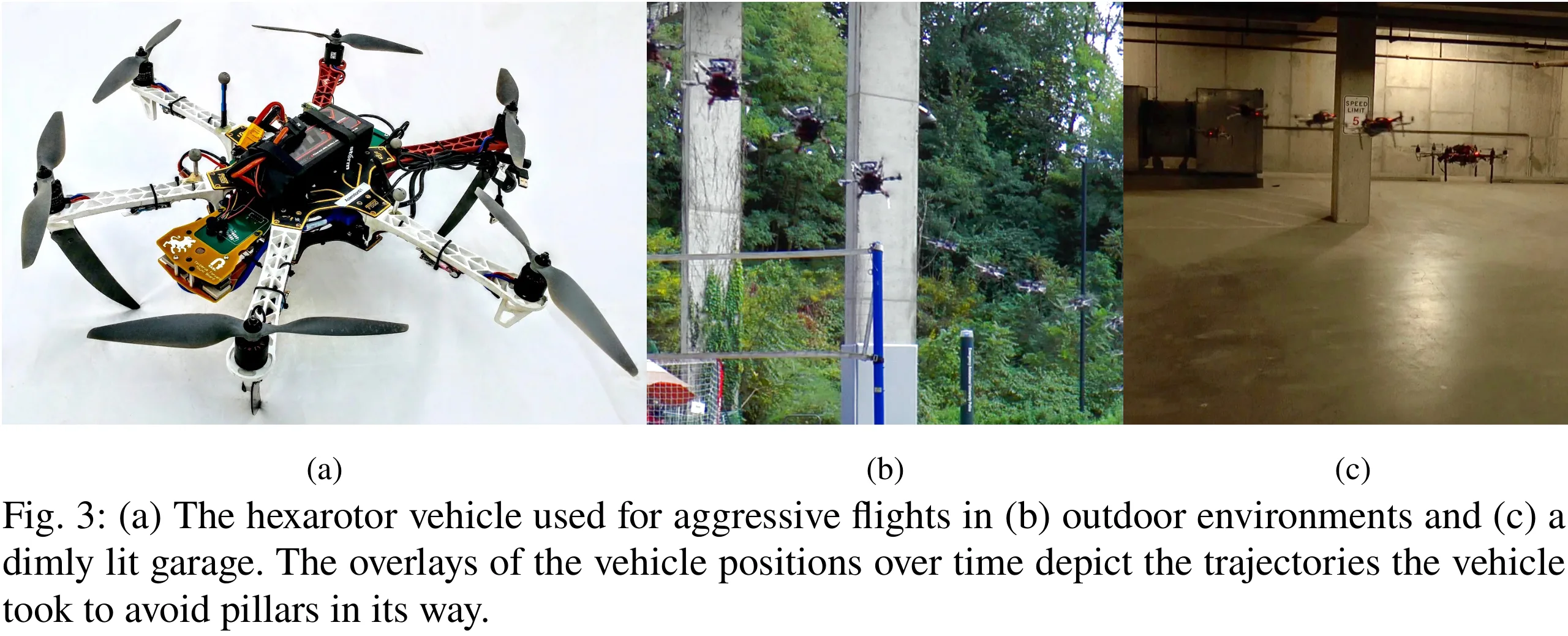
Platform and Environments (a) The hexarotor vehicle used for aggressive flights in (b) outdoor environments and (c) a dimly lit garage. The overlays of the vehicle positions over time depict the trajectories the vehicle took to avoid pillars in its way.
High-Speed Flight Tracking
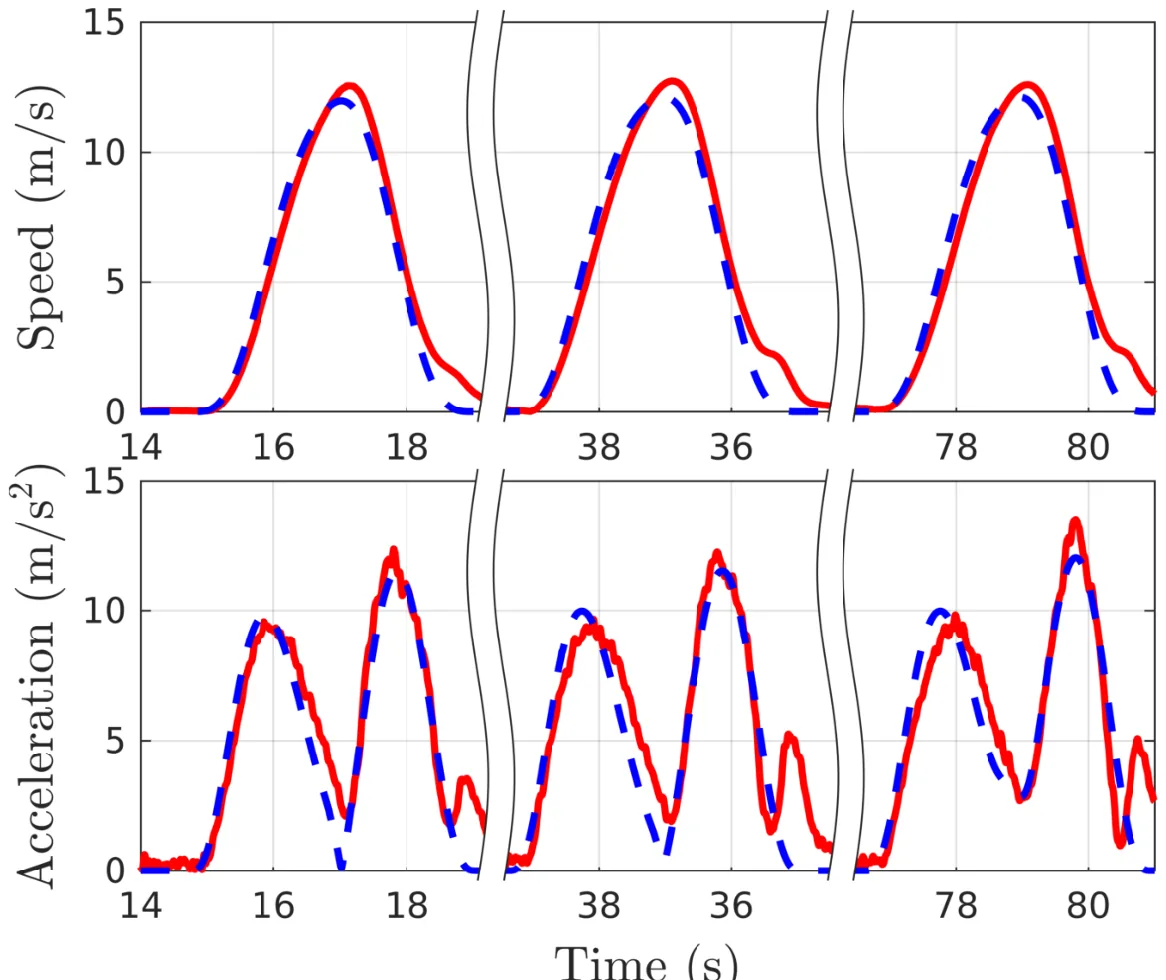
High-Speed Flight Tracking Desired (dashed blue) vs. estimated (solid red) speed and acceleration achieved during high speed flight in experiment Outdoor-1. A maximum acceleration of 13.5 m/s2 was attained.
Collision Avoidance Snapshot
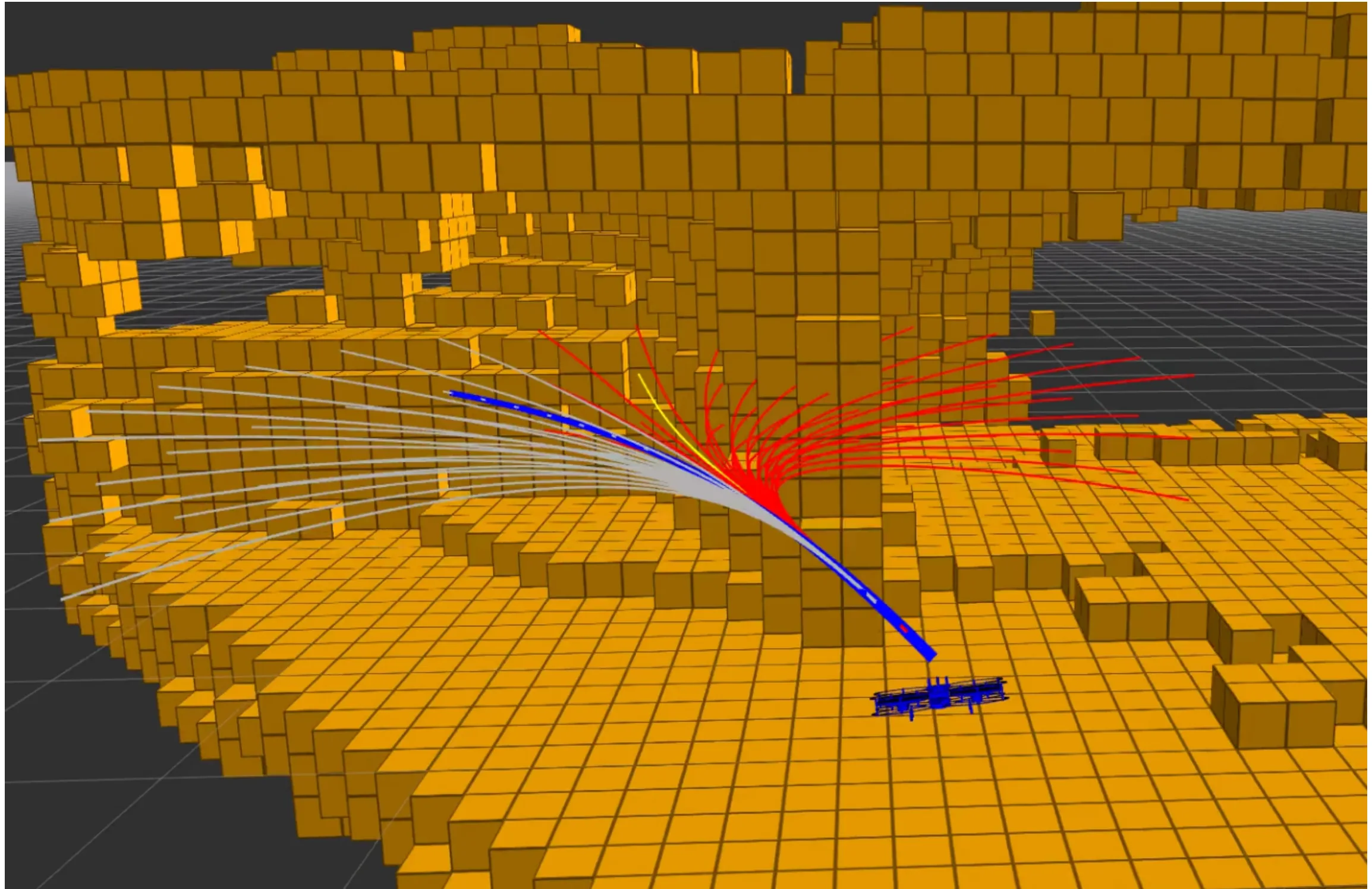
Collision Avoidance Snapshot A snapshot of the map and motion primitive library during an indoor experiment when the user selected trajectory (yellow) is not chosen to avoid a collision.
Collision Avoidance Experiments
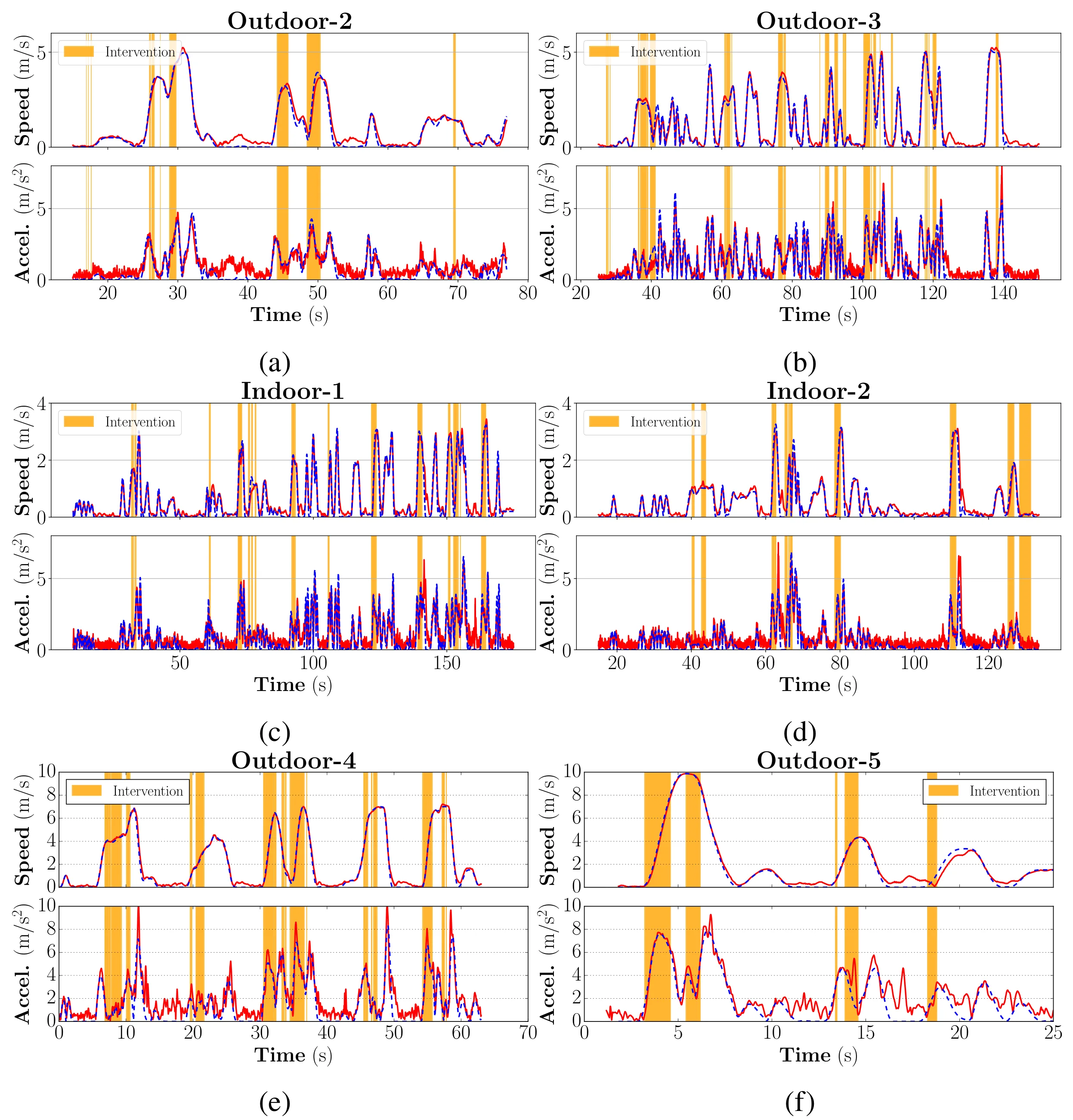
Collision Avoidance Experiments Desired (dashed blue) vs. estimated (solid red) speed and acceleration achieved during our six collision avoidance experiments. During orange regions, the operator's trajectory was not selected in order to keep a minimum distance to surrounding obstacles. The system accurately tracks trajectory references and avoids obstacles while reaching speeds of up to 10 m/s, and accelerations up to 8 m/s2.

BibTeX

@inproceedings{fast-agile-vision-flight-2018,
  title={Fast and Agile Vision-Based Flight with Teleoperation and Collision Avoidance on a Multirotor},
  author={Alex Spitzer, Xuning Yang, John Yao, Aditya Dhawale, Kshitij Goel, Mosam Dabhi, Matt Collins, Curtis Boirum, and Nathan Michael},
  booktitle={International Symposium on Experimental Robotics (ISER), 2018},
  year={2018}
}