Shared Autonomy for Human-Robot Teams
Implicit coordination and wearable sensing that let humans and robots share one exploration task without explicit commands.
We develop interfaces and coordination frameworks in which neither the human nor the robot is fully in charge — autonomy is shared, and coordination emerges from observing each other rather than from explicit commands.
Most autonomous exploration systems keep a remote operator outside the loop, issuing explicit goals to the robot. We instead study a spectrum of shared autonomy — from the human flying while the machine guarantees safety, to the robot inferring goals from the human’s gaze, to teams that need no per-goal direction at all. Across it, the division of control shifts, but coordination emerges from observation rather than commands.
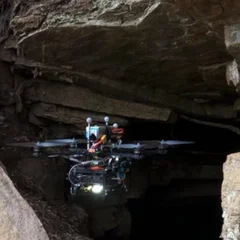
At the tightest coupling, the human pilots directly while the robot owns safety. Our teleoperation approach maps operator inputs onto smooth motion primitives and modulates the vehicle’s maximum speed through hierarchical collision checking that adapts local map resolution to clutter at 10 Hz — letting a non-expert fly fast in open space and slow through tight passages without ever setting a speed.
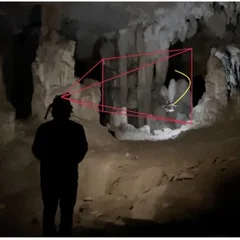
Loosening that coupling, the human need only look. A helmet-mounted depth camera implicitly communicates a region of interest, and an information-gain objective biases the robot’s motion planning toward the viewpoint the human is already attending to — so the aerial system safely reaches areas that may not be viewable or reachable by the human, with no explicit command issued.
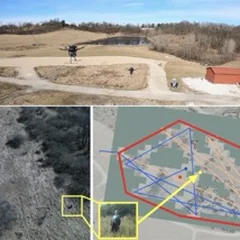
At the far end, the human specifies intent, not paths. Rather than following preprogrammed routes, a decentralized team of aerial robots biases its own trajectories toward resolving uncertainty over target locations, sharing information opportunistically and fusing detections across vehicles — validated in search-and-rescue field experiments that localized all a priori unknown targets to within a few meters.