Kshitij Goel Robotics Researcher

Hierarchical Collision Avoidance for Adaptive-Speed Multirotor Teleoperation

SSRR · 2022

Best Paper Award

How do we assist non-experts in flying a multirotor in a way they do not have to adjust the speed inputs in environments with varying clutter?

This paper improves safe motion primitives-based teleoperation of a multirotor by developing a hierarchical collision avoidance method that modulates maximum speed based on environment complexity and perceptual constraints. Safe speed modulation is challenging in environments that exhibit varying clutter. Existing methods fix maximum speed and map resolution, which prevents vehicles from accessing tight spaces and places the cognitive load for changing speed on the operator. We address these gaps by proposing a high-rate (10 Hz) teleoperation approach that modulates the maximum vehicle speed through hierarchical collision checking. The hierarchical collision checker simultaneously adapts the local map's voxel size and maximum vehicle speed to ensure motion planning safety. The proposed methodology is evaluated in simulation and real-world experiments and compared to a non-adaptive motion primitives-based teleoperation approach. The results demonstrate the advantages of the proposed teleoperation approach both in time taken and the ability to complete the task without requiring the user to specify a maximum vehicle speed.

Figures

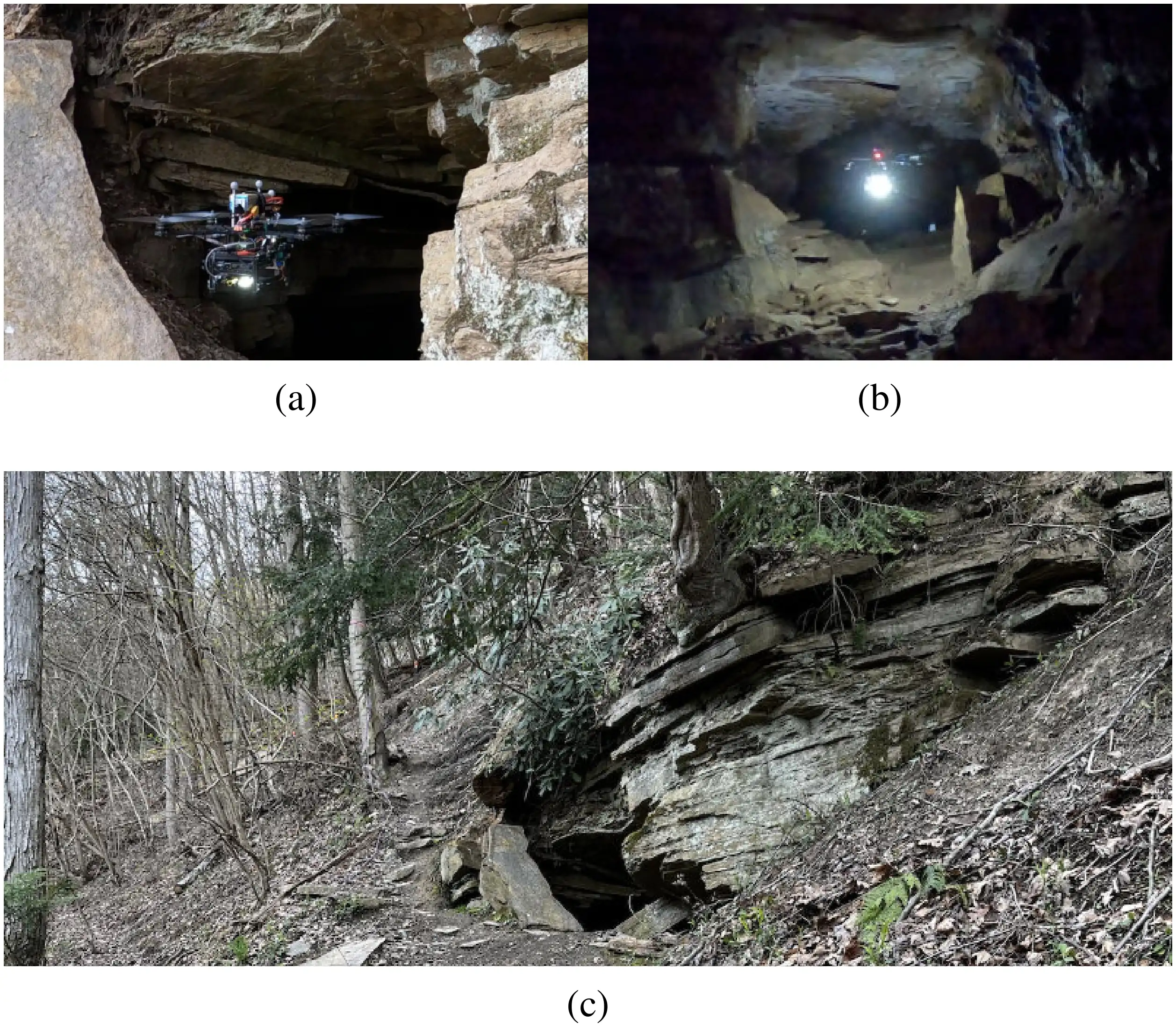
Field Deployment
Field Deployment Tele-operated multirotor adapts the motion planning speed and local map resolution to (a) enter a cave and (b) traverse a tight passage inside. (c) illustrates the surroundings near the cave entrance, which is embedded in a sloping hillside. A video of this experiment can be found at https://youtu.be/VjyoPVXT8WY.
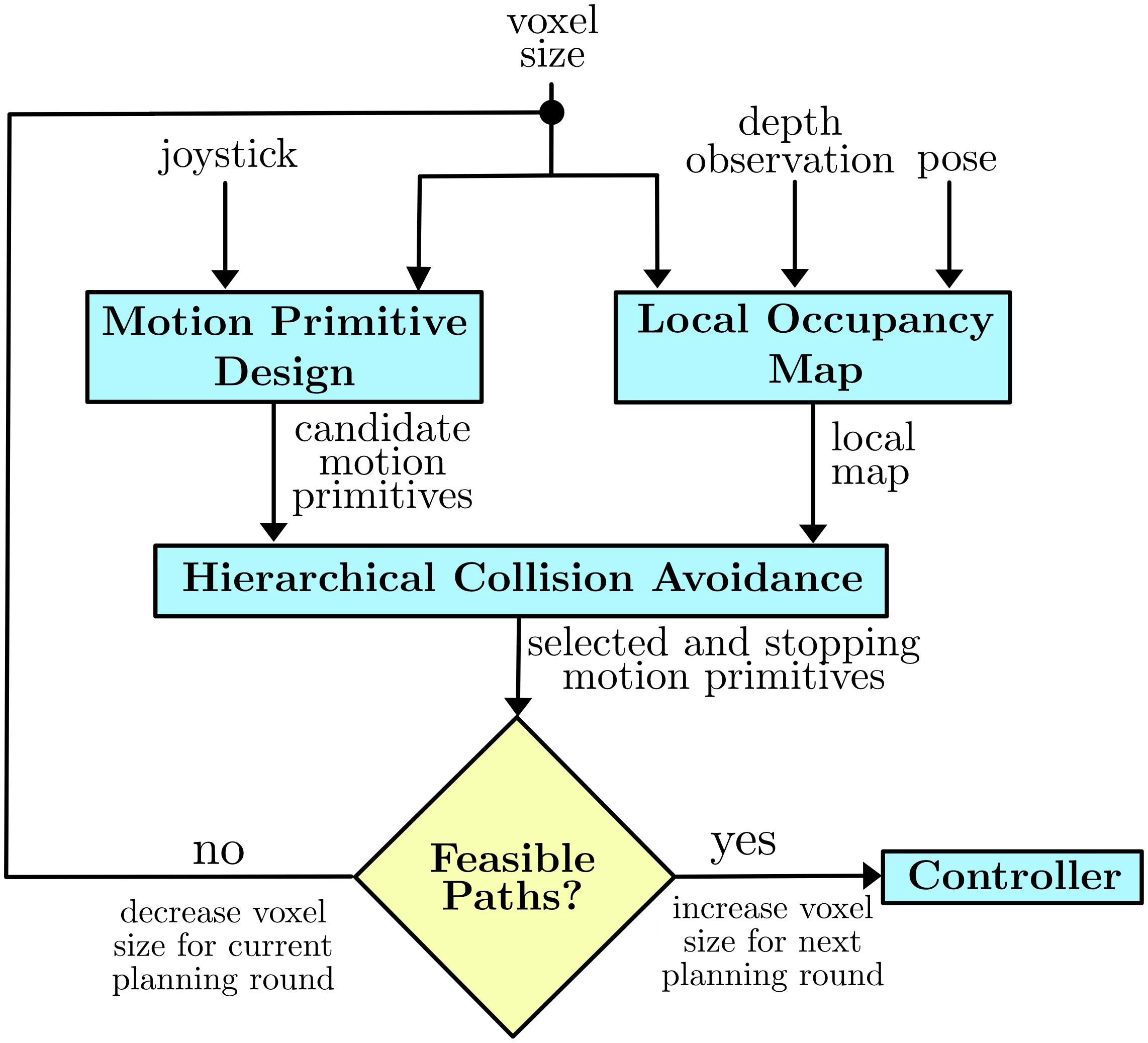
Information Flow
Information Flow Information flow diagram for the technical approach.
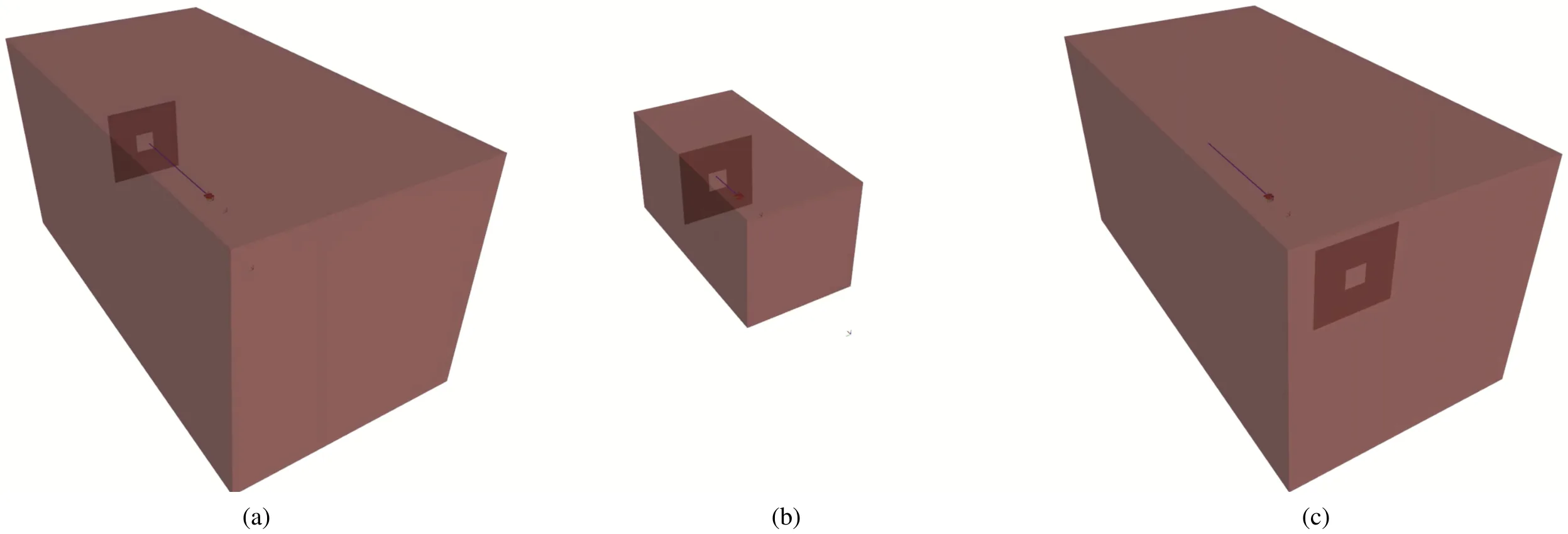
Bounding Box Design
Bounding Box Design Bounding box extents for a scenario where the robot traverses a window. The teleoperator gives maximum joystick input in the forward direction for these three figures. (a) When the robot is far from the window, the bounding box extents and local occupancy map are large because the voxel size is also large. (b) As the multirotor gets closer to the window, the voxel size decreases and so does the bounding box extent because the number of voxels in the map stays the same. (c) After exiting the window, the bounding box expands to the original size. Note that the change in bounding box extents is achieved by varying the voxel size and keeping the number of voxels constant.
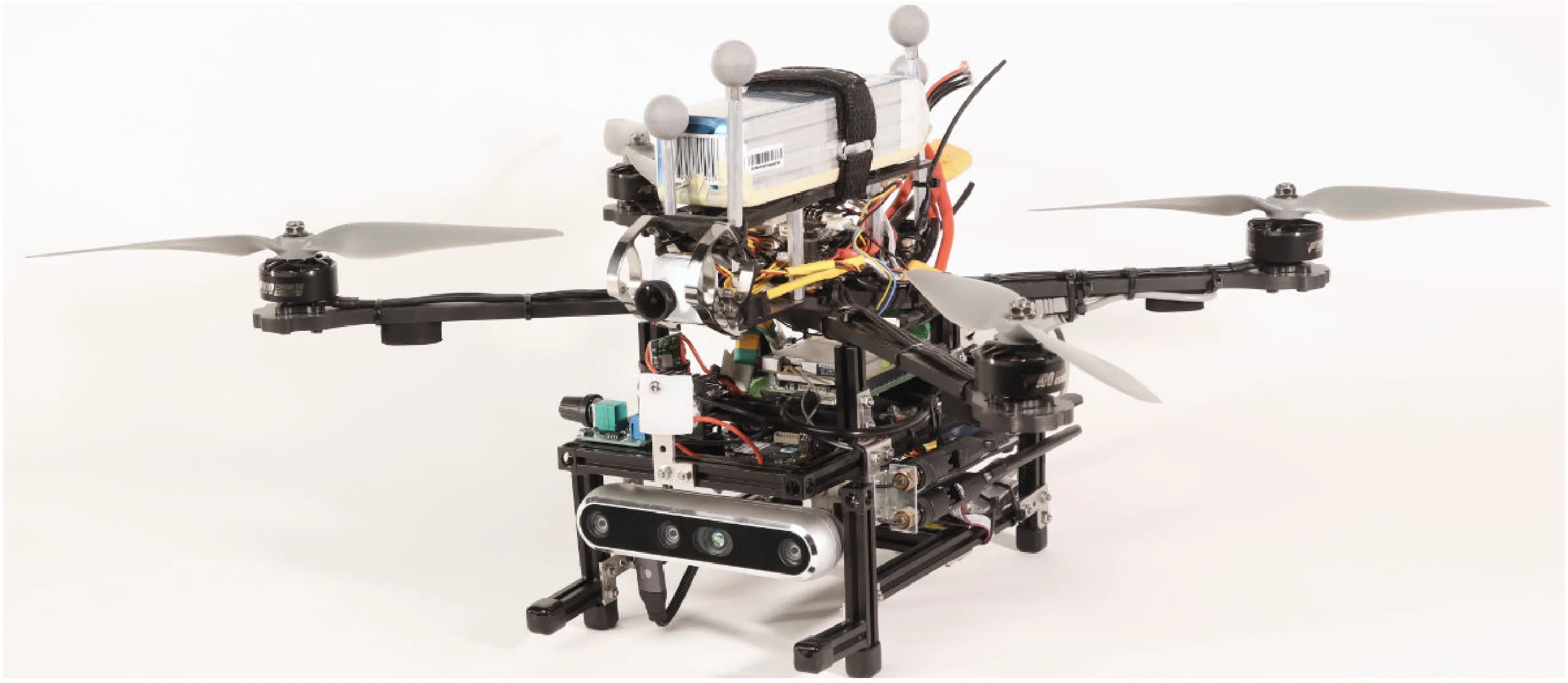
Robot Platform
Robot Platform The robot used in the field experiments is equipped with a forward-facing Intel Realsense D455, downward-facing mvBluefox global shutter color camera, and Pixracer flight controller.
Simulated Window Task
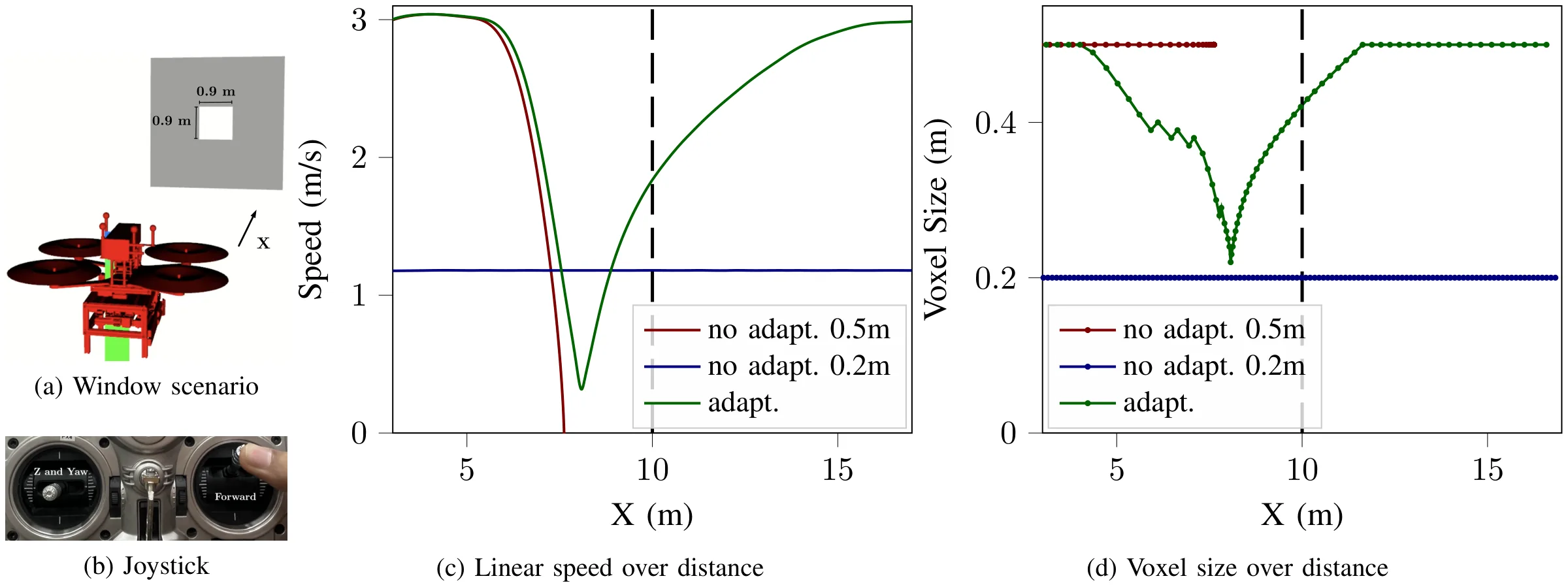
Simulated Window Task Performance comparison for the simulated window teleoperation task. (a) depicts the initial conditions for the task. A multirotor hovers at a distance of 10 m from a window of dimensions 0.9 m × 0.9 m. The operator controls the multirotor via the joystick shown in (b). The operator intends to go forward at the highest speed possible. (c) and (d) show the variation of the forward speed and the local map voxel size as a function of the distance from the window for the three teleoperation approaches.
Varying-Clutter Cave Scenario
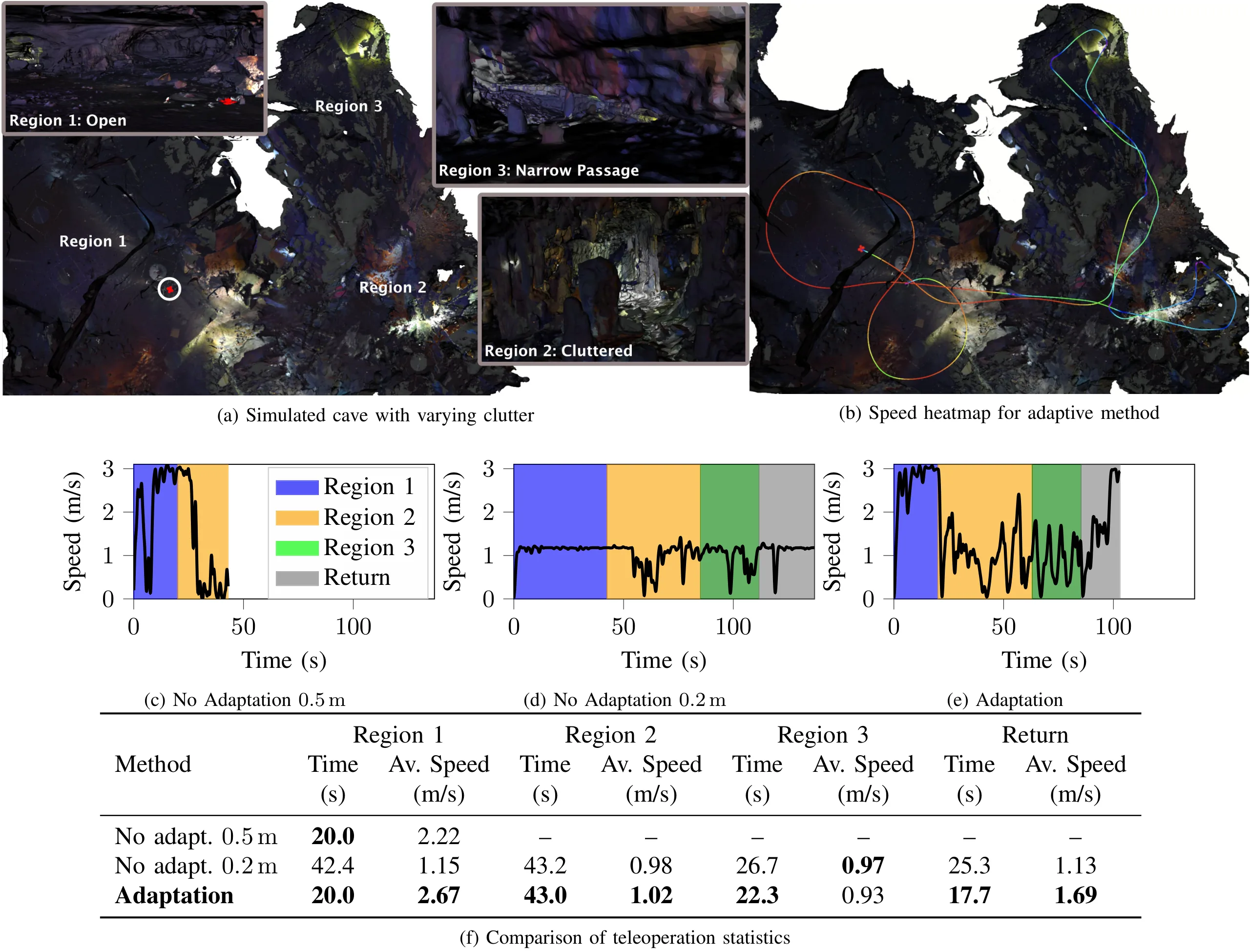
Varying-Clutter Cave Scenario Performance comparison for the (a) varying-clutter cave scenario with three different spaces: Region 1 is an open space, Region 2 is cluttered, and Region 3 is a narrow passage. The speeds achieved by the robot for each method are plotted over time in (c), (d), and (e). The graphs and the table in (f) demonstrate that the (c) No Adaptation 0.5 m variant cannot complete the circuit, while both the (d) No Adaptation 0.2 m and (e) Adaptation variants successfully traverse all regions. Our method completes the circuit in the least time while modulating speeds, as illustrated in the heatmap in (b). A video of this experiment can be found at https://youtu.be/VjyoPVXT8WY.
Door Teleoperation Task
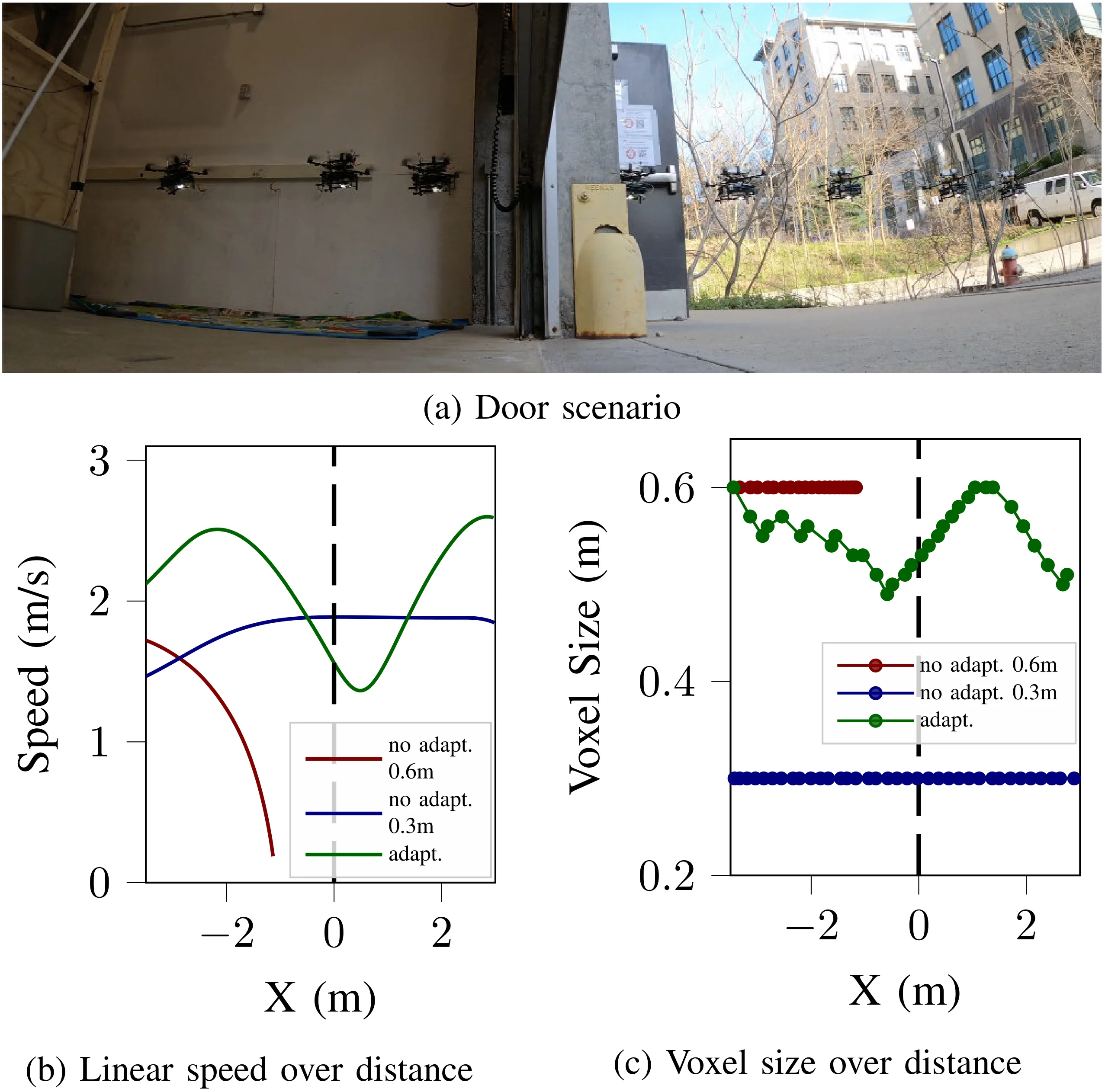
Door Teleoperation Task Performance comparison for the door teleoperation task. (a) a robot starts at hover from outside a building and the operator intends to enter the building at the maximum possible forward speed (Fig. 5b) through a door of width 0.9 m. (b) and (c) show the speeds and voxel sizes as a function of distance from the door. A video of this experiment can be found at https://youtu.be/ VjyoPVXT8WY.
Cave Teleoperation Task
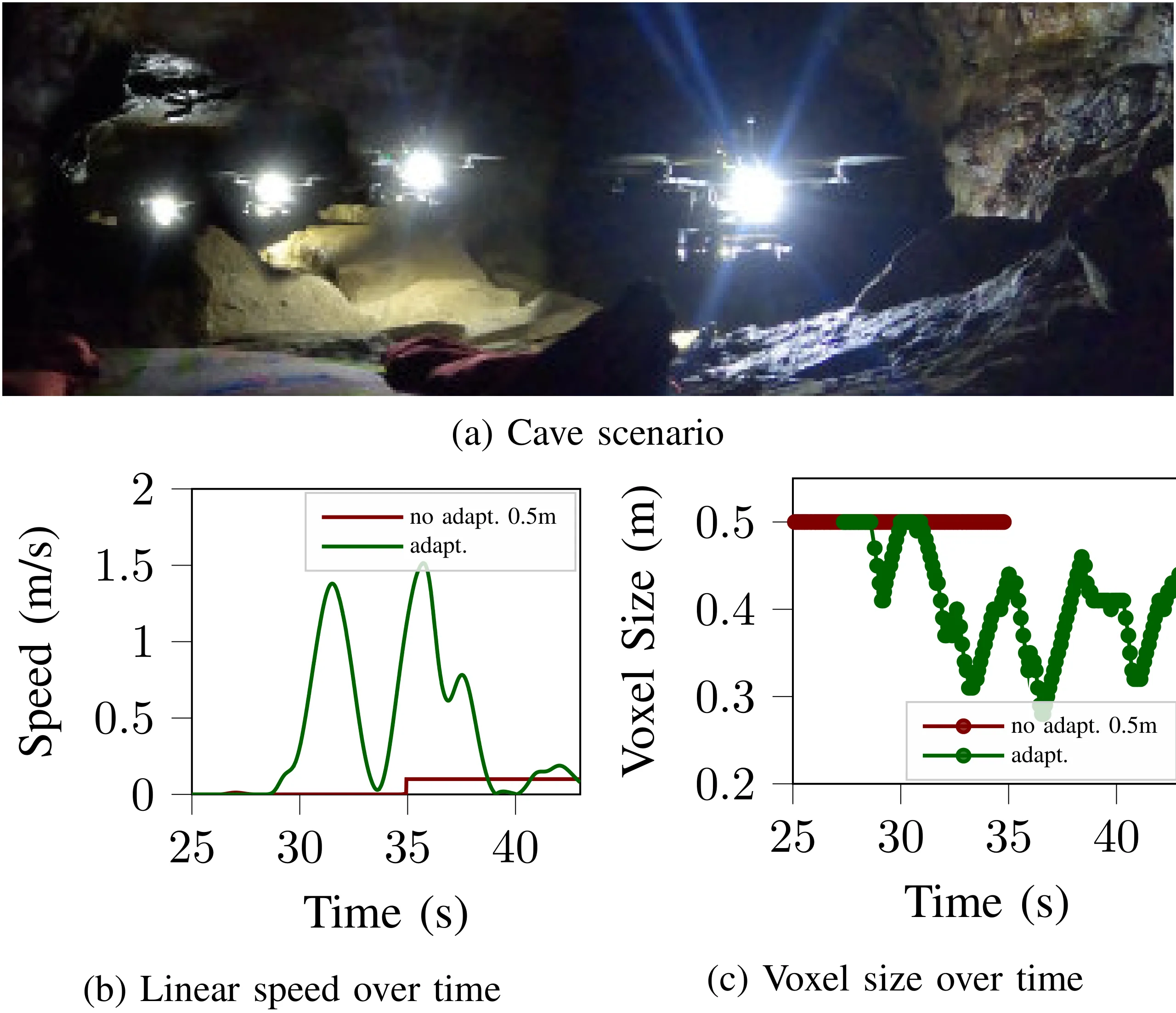
Cave Teleoperation Task Performance comparison for the cave teleoperation task. (a) a robot starts at hover from a relatively spacious part of a cave passage. The operator intends to go through the passage at the maximum possible forward speed (Fig. 5b). (b) and (c) show the speeds and map voxel sizes as a function of time. Without map adaptation, the robot is unable to go through the narrow passage and the operator must land the robot around the 35 s mark. With map adaptation, the speeds are adapted according to the environment complexity and the robot traverses the narrow passage. A video of this experiment can be found at https: //youtu.be/VjyoPVXT8WY.

Acknowledgments

The authors thank the Mid Atlantic Karst Conservancy for granting permission to test at a cave on the Barbara Schomer Cave Preserve. The authors also thank D. Wettergreen and S. Vats for their feedback on this manuscript.

BibTeX

@inproceedings{hierarchical-collision-avoidance-2022,
  title={Hierarchical Collision Avoidance for Adaptive-Speed Multirotor Teleoperation},
  author={Kshitij Goel, Yves Georgy Daoud, Nathan Michael, and Wennie Tabib},
  booktitle={IEEE International Symposium on Safety, Security, and Rescue Robotics (SSRR), 2022},
  year={2022}
}