Kshitij Goel Robotics Researcher

Probabilistic Point Cloud Modeling via Self-Organizing Gaussian Mixture Models

RAL · 2023

To compress a multimodal point cloud into a Gaussian Mixture Model (GMM), how many Gaussian components should we use?

This letter presents a continuous probabilistic modeling methodology for spatial point cloud data using finite Gaussian Mixture Models (GMMs) where the number of components are adapted based on the scene complexity. Few hierarchical and adaptive methods have been proposed to address the challenge of balancing model fidelity with size. Instead, state-of-the-art mapping approaches require tuning parameters for specific use cases, but do not generalize across diverse environments. To address this gap, we utilize a self-organizing principle from information-theoretic learning to automatically adapt the complexity of the GMM model based on the relevant information in the sensor data. The approach is evaluated against existing point cloud modeling techniques on real-world data with varying degrees of scene complexity.

Figures

Method Teaser
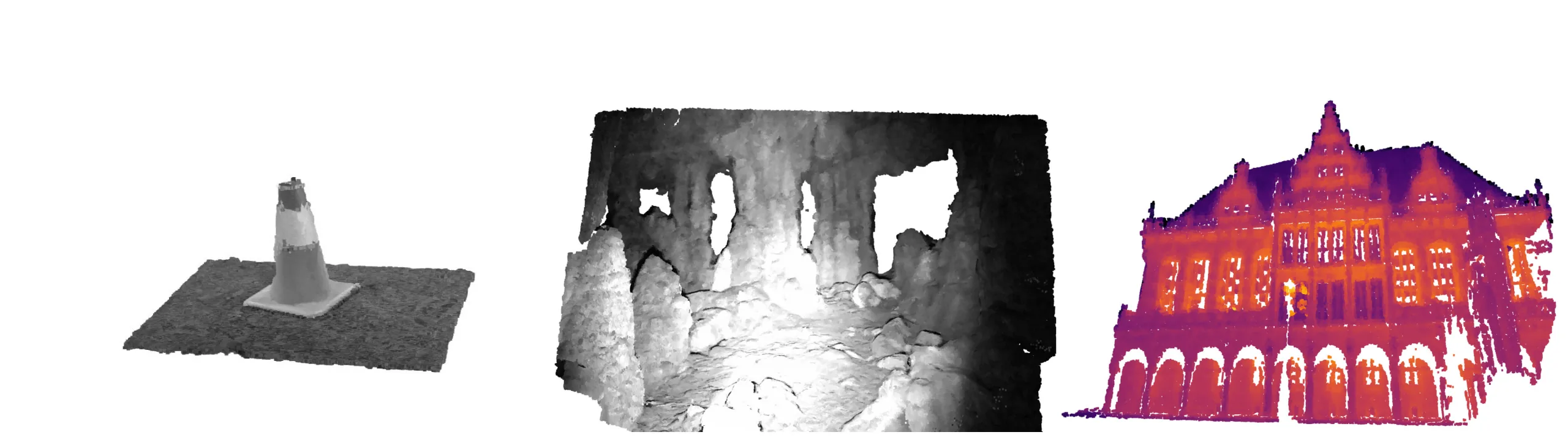
Method Teaser The methodology proposed in this work enables multi-modal reconstruction at varying scales. Without modifying parameters, the methodology models depth and grayscale data of small objects (1 m x 1 m safety cone in the left image) and complex environments (10 m x 5 m cave in the center image) while also modeling depth and thermal data of (right) large-scale buildings (42 m x 28 m).
System Details
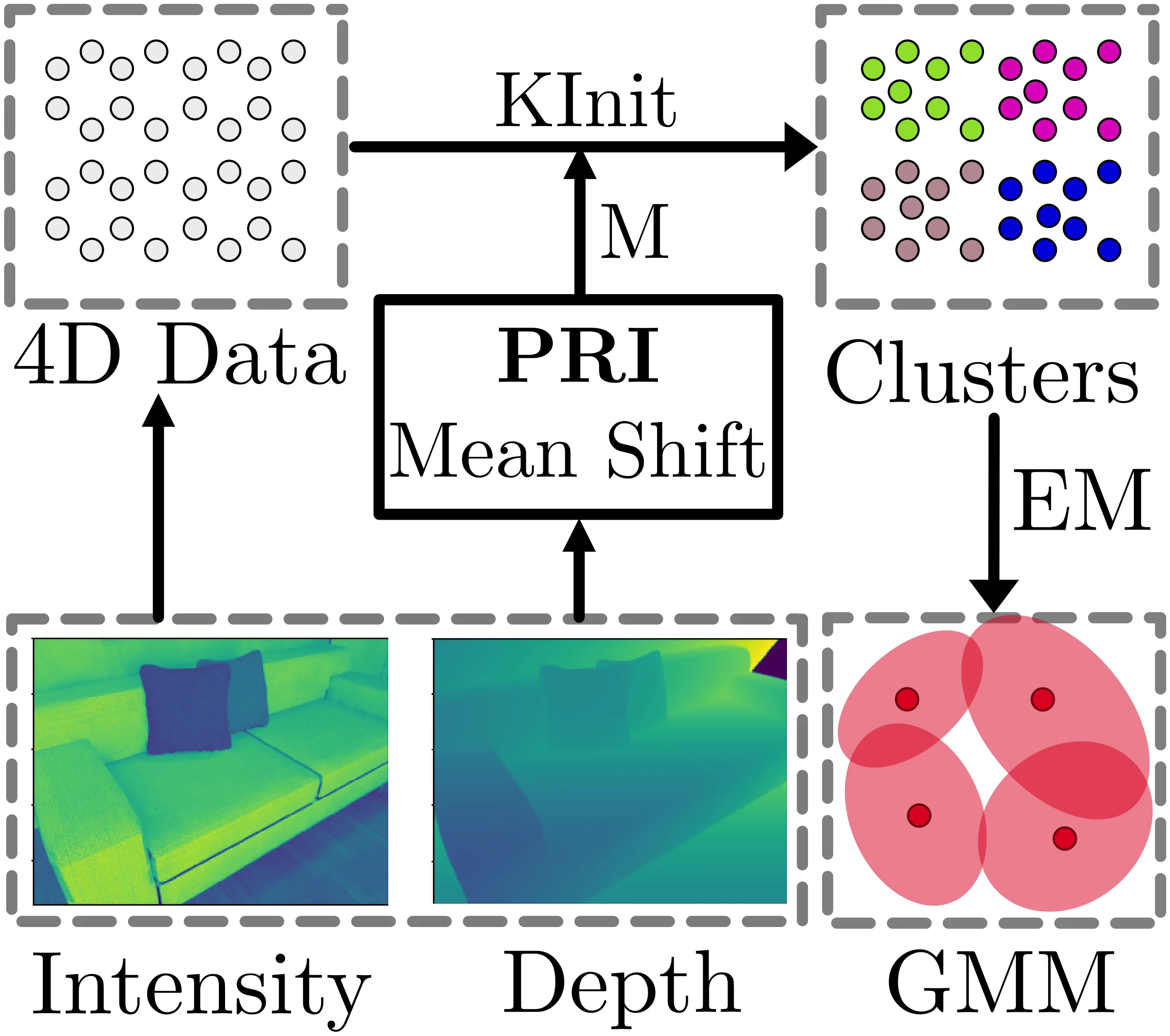
System Details (Left) An illustration of the key idea behind the proposed methodology. Given a registered pair of intensity and depth images, the principle of relevant information (PRI) determines the number of components required to model the 4D point cloud associated with the images using a GMM. (Right) The effect of using the PRI is automatic adjustment in model complexity across scenes of different fidelity.
Model Size Adaptation
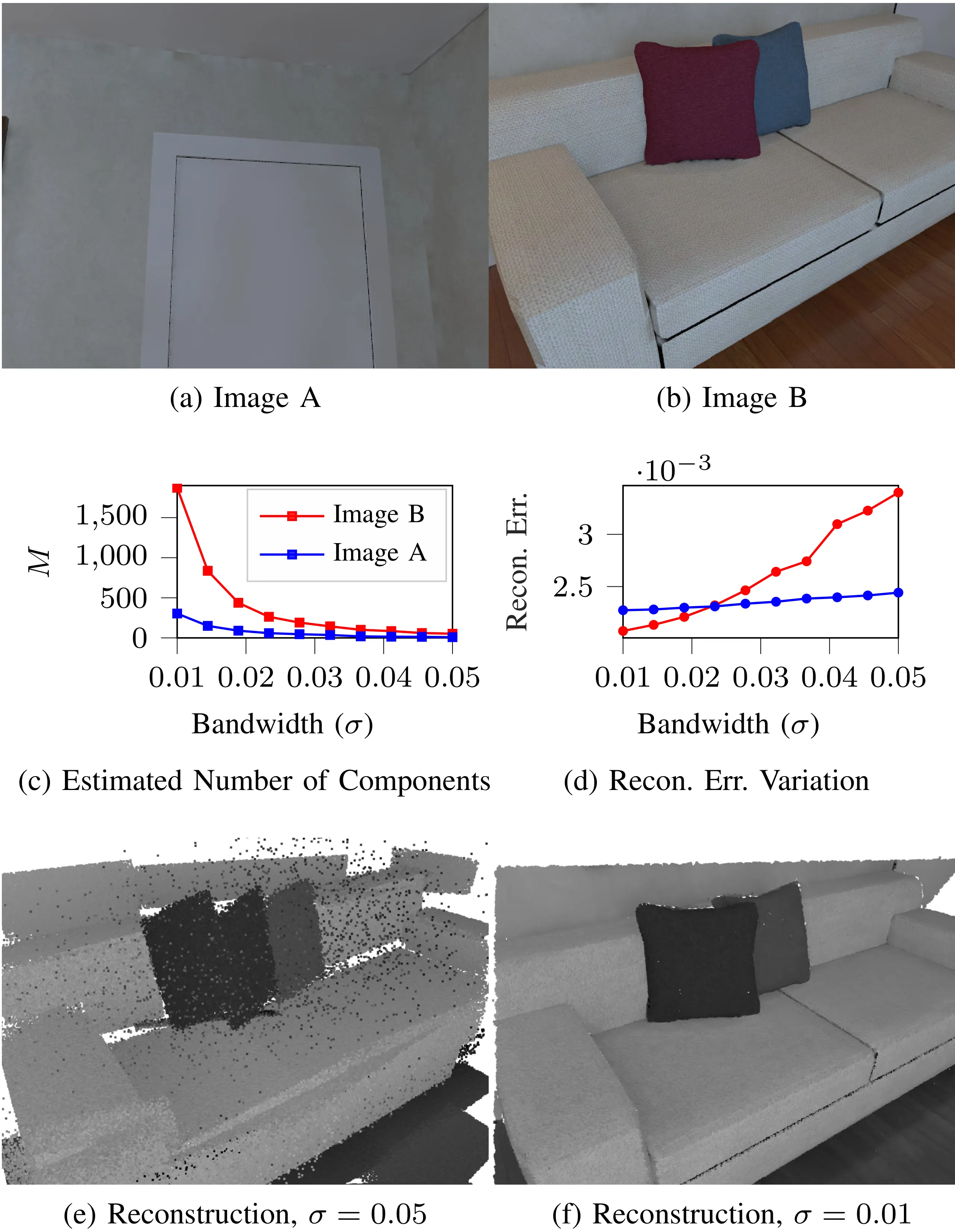
Model Size Adaptation A study on how the PRI (Eq. (1)) component in the SOGMM system (Fig. 2) adapts the model size according to the scene complexity. A simple scene consisting of (a) homogeneous, white walls requires fewer components than a (b) complex scene consisting of discrete, structured objects. (c) plots the number of components required to represent each of the two scenes for a given bandwidth parameter, σ. (d) plots the mean reconstruction error variation with σ. (e) and (f) show the reconstruction result for the extrema bandwidths in (d). Note how the SOGMM formulation selects more components to represent the complex scene for a given bandwidth value. Further, the reconstruction error varies monotonically with σ.
Resampled Reconstructions
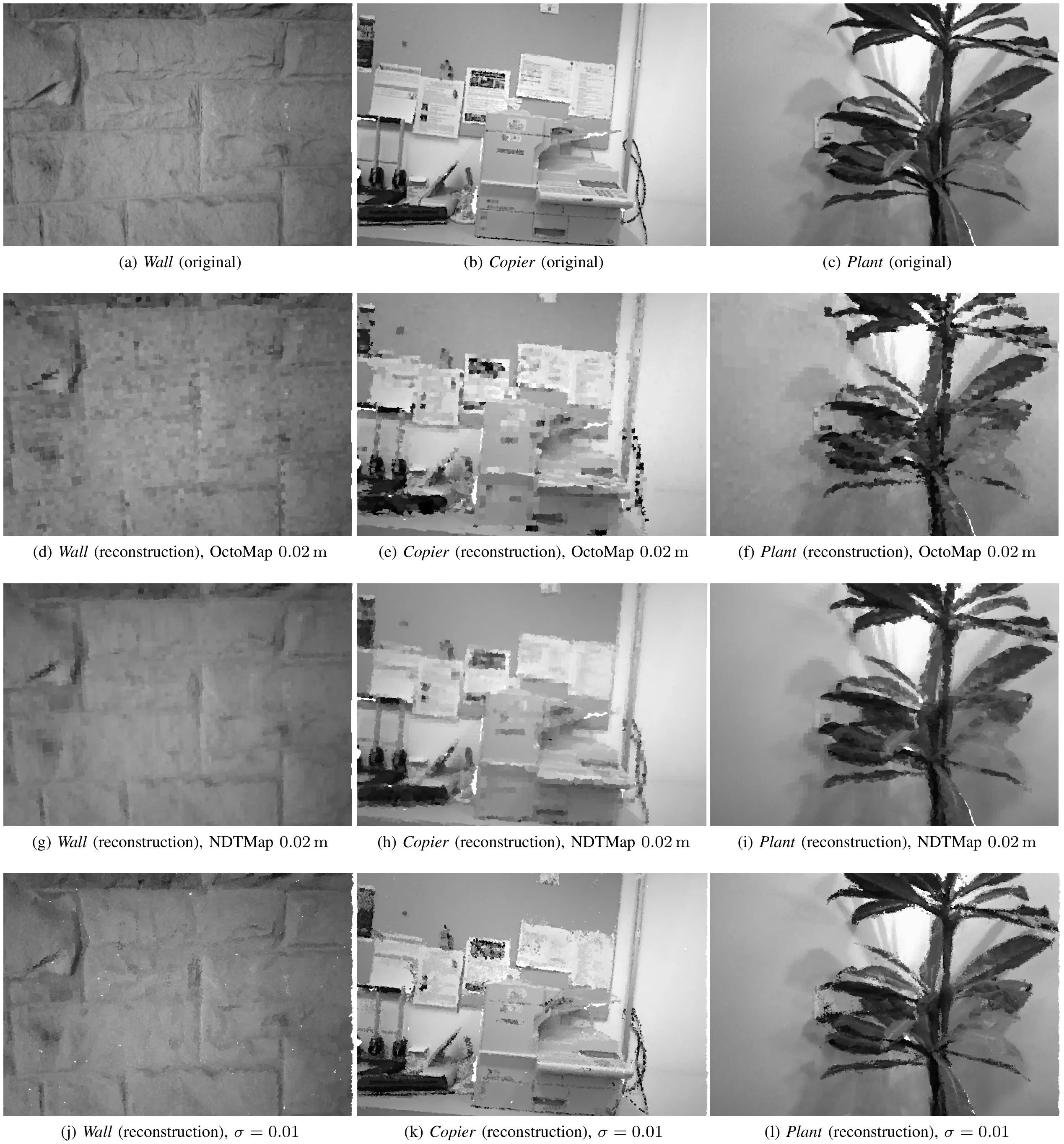
Resampled Reconstructions Resampled output from SOGMMs created for three point clouds with different levels of complexity. The point clouds are taken from real-world datasets [45]. The OctoMap method results in a pixelated output. NDTMap allows a smoother output at a cost of high memory usage. The SOGMM method adapts the complexity of the mixture model without changing parameters across different scenes (σ = 0.01 for all the cases). A supplementary video may be found at https://youtu.be/v0DfhK1lyno.
Quantitative Evaluation
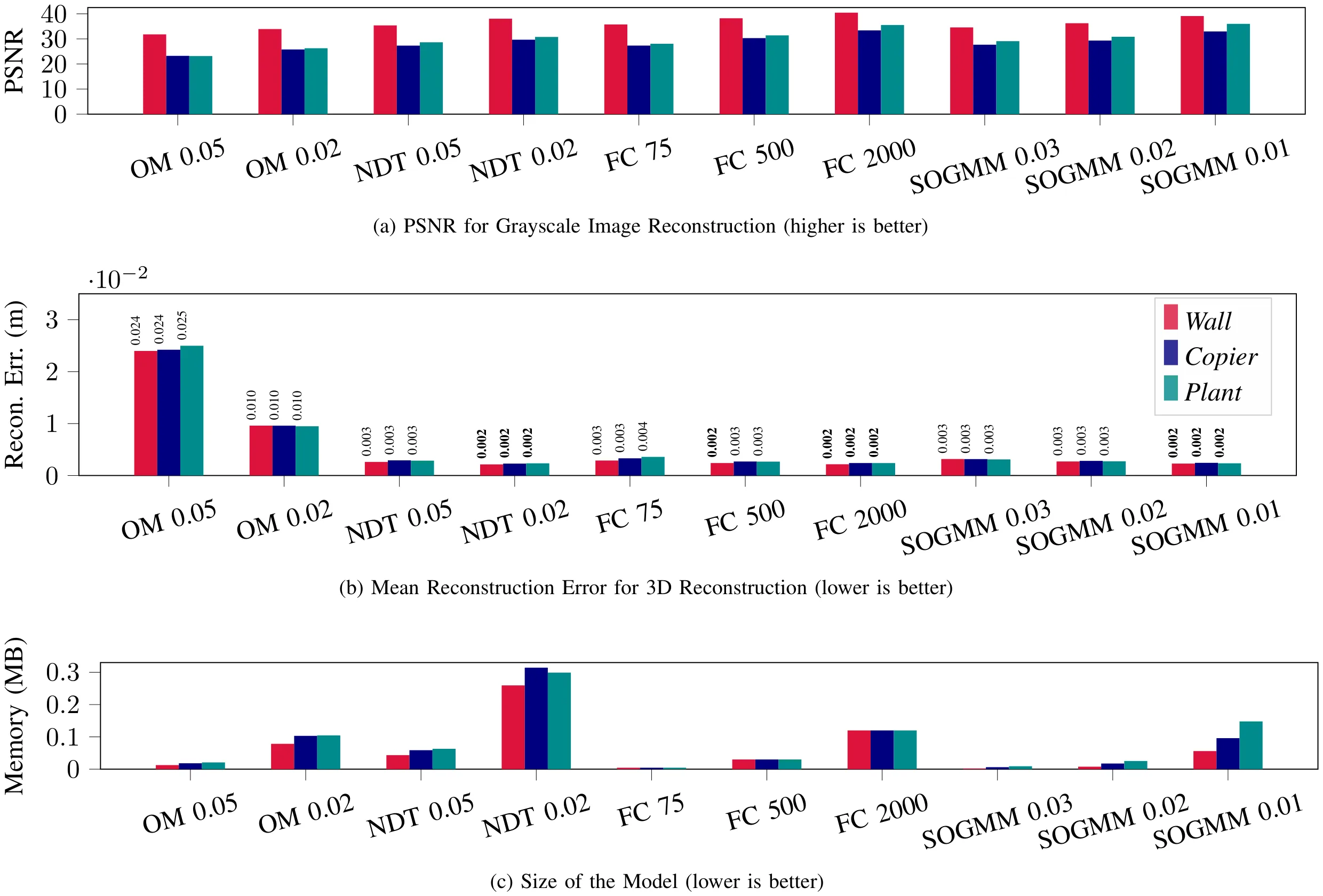
Quantitative Evaluation Quantitative evaluation of the SOGMM method for the scenes shown in Fig. 4. The SOGMM approach enables high accuracy (a) grayscale and (b) 3D reconstructions while allowing (c) adaptation in the size of the model without changing the bandwidth parameter across scenes.

BibTeX

@article{goel2023probabilistic,
	title={Probabilistic point cloud modeling via self-organizing Gaussian mixture models},
	author={Goel, Kshitij and Michael, Nathan and Tabib, Wennie},
	journal={IEEE Robotics and Automation Letters},
	volume={8},
	number={5},
	pages={2526--2533},
	year={2023},
	publisher={IEEE}
}