Kshitij Goel Robotics Researcher

Distance and Collision Probability Estimation from Gaussian Surface Models

IROS · 2025

Can we enable collision avoidance from surfaces when the surfaces are incrementally revealed to the robot through a depth sensor and compressed into a set of Gaussians?

Kshitij Goel Wennie Tabib

This paper describes methodologies to estimate the collision probability, Euclidean distance and gradient between a robot and a surface, without explicitly constructing a free space representation. The robot is assumed to be an ellipsoid as opposed to the commonly used spherical model, thus providing a tighter approximation for navigation in cluttered and narrow spaces. Instead of computing distances over raw point clouds or large high-resolution occupancy grids, the environment is modeled using Gaussian mixture models and approximated via a set of ellipsoids. A parallelizable strategy to accelerate an existing ellipsoid-ellipsoid distance computation method is presented. Evaluation in 3D environments demonstrates improved performance over a state-of-the-art Gaussian Process-based method. Execution times for the approach are within a few microseconds per ellipsoid pair using a single-thread on low-power embedded computers.

Figures

Method Teaser
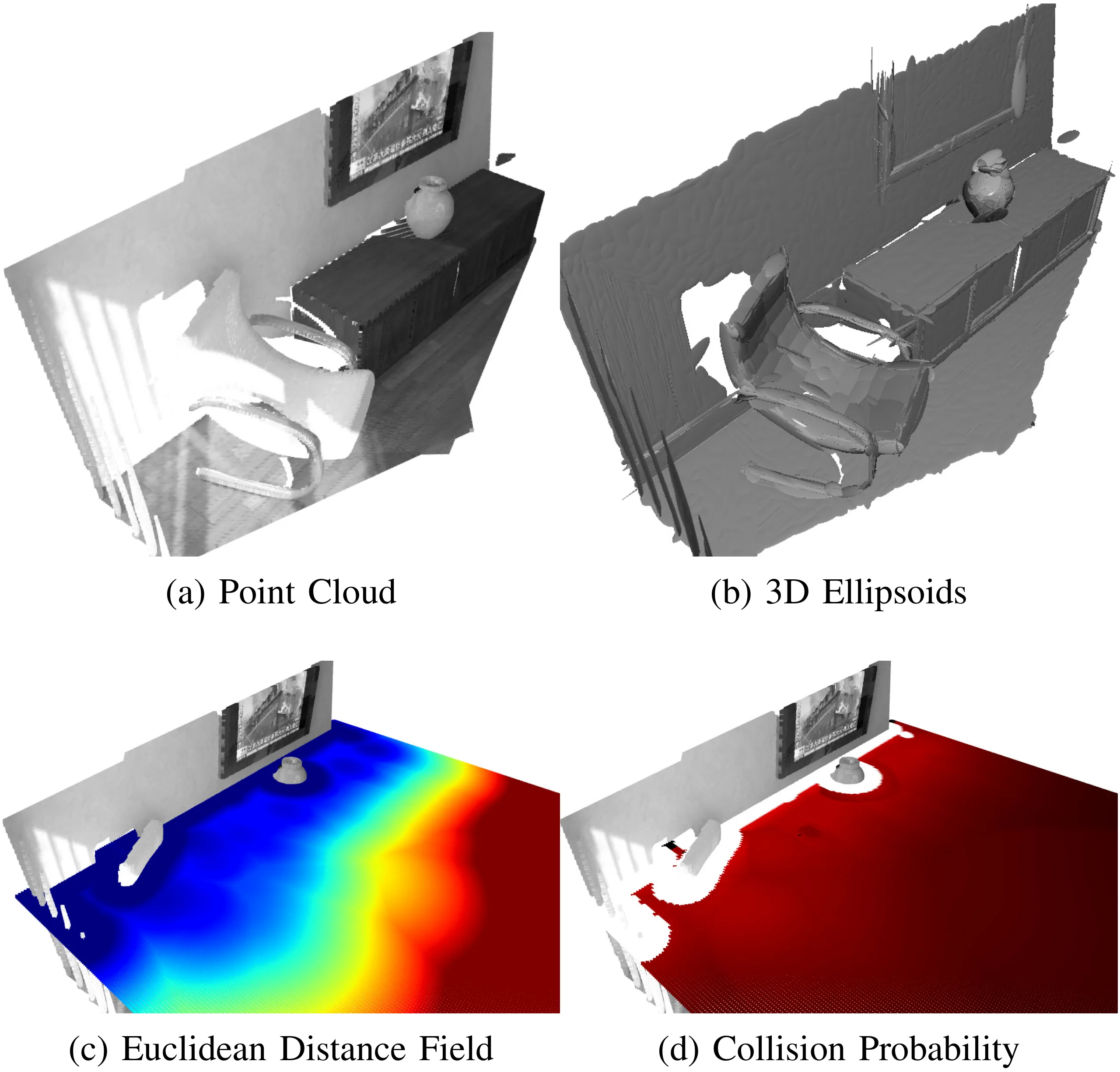
Method Teaser This work contributes methods to estimate continuous-space collision probability, Euclidean distance and gradient of an ellipsoidal robot body model from a Gaussian surface model (GSM) of the surface. A 3D point cloud is approximated with a GMM, shown as a set of ellipsoids. The Euclidean distance over a 2D slice predicted by the proposed approach is shown as a heatmap (increasing distances from blue to red). The collision probability values (decreasing from red to black, 1.0 in white regions) over the same 2D slice when the robot position is uncertain.
System Details
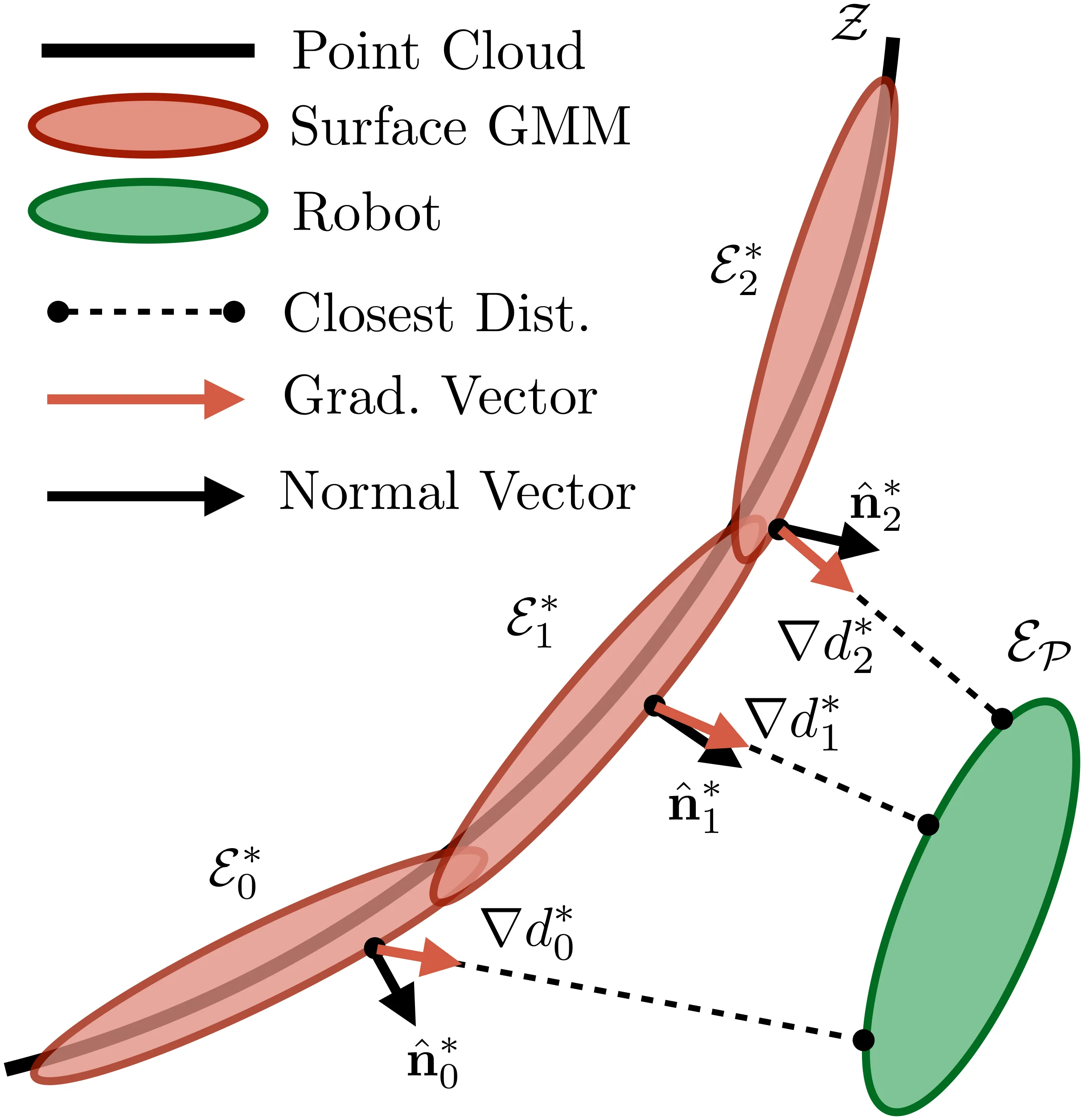
System Details Illustration of various quantities involved in the proposed methods for Euclidean distance, gradient, and collision probability estimation.
Euclidean Distance Field Comparison
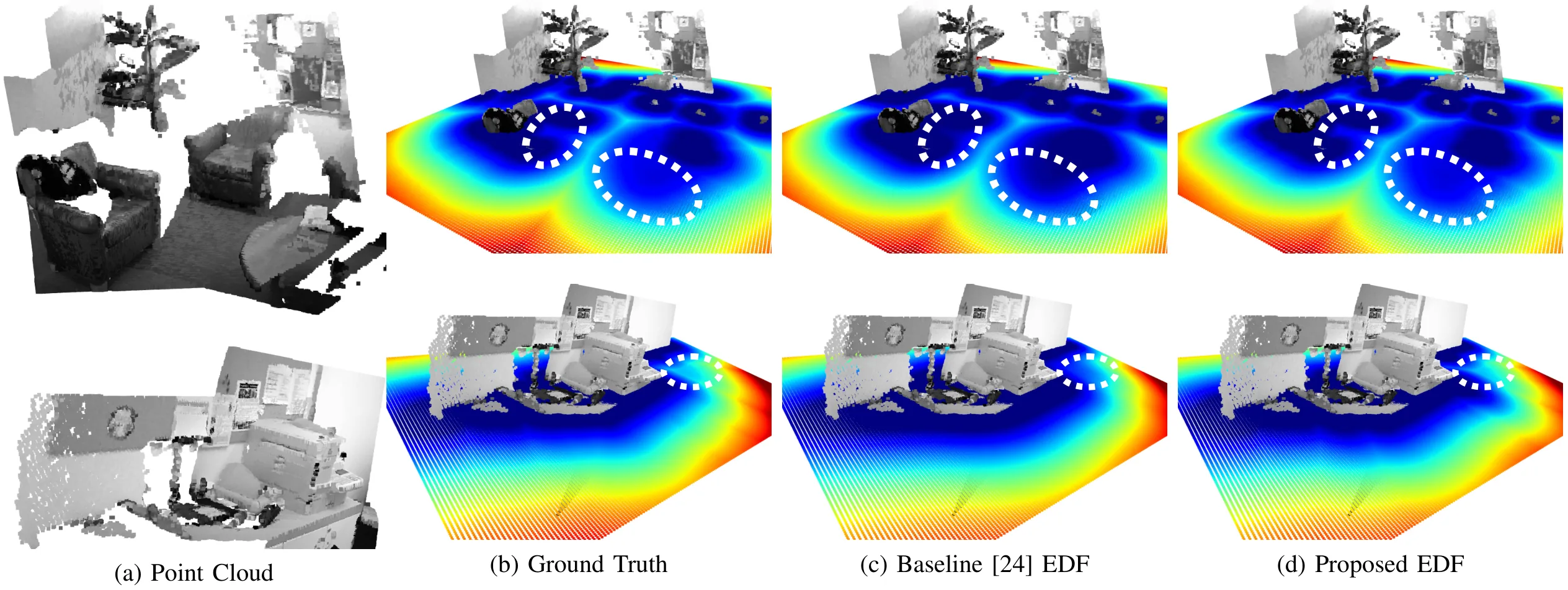
Euclidean Distance Field Comparison Heatmaps for (b) ground truth, (c) baseline [24], and (d) proposed EDFs generated using the real-world 3D point cloud shown in (a). Note the difference in baseline and proposed EDFs relative to the ground truth in the dashed white regions. The dark blue regions are bigger in the baseline demonstrating conservative EDF estimation due to an implicit spherical robot body assumption. The proposed approach accounts for the ellipsoidal robot body while enabling continuous-space queries.
Estimation Error Heatmaps
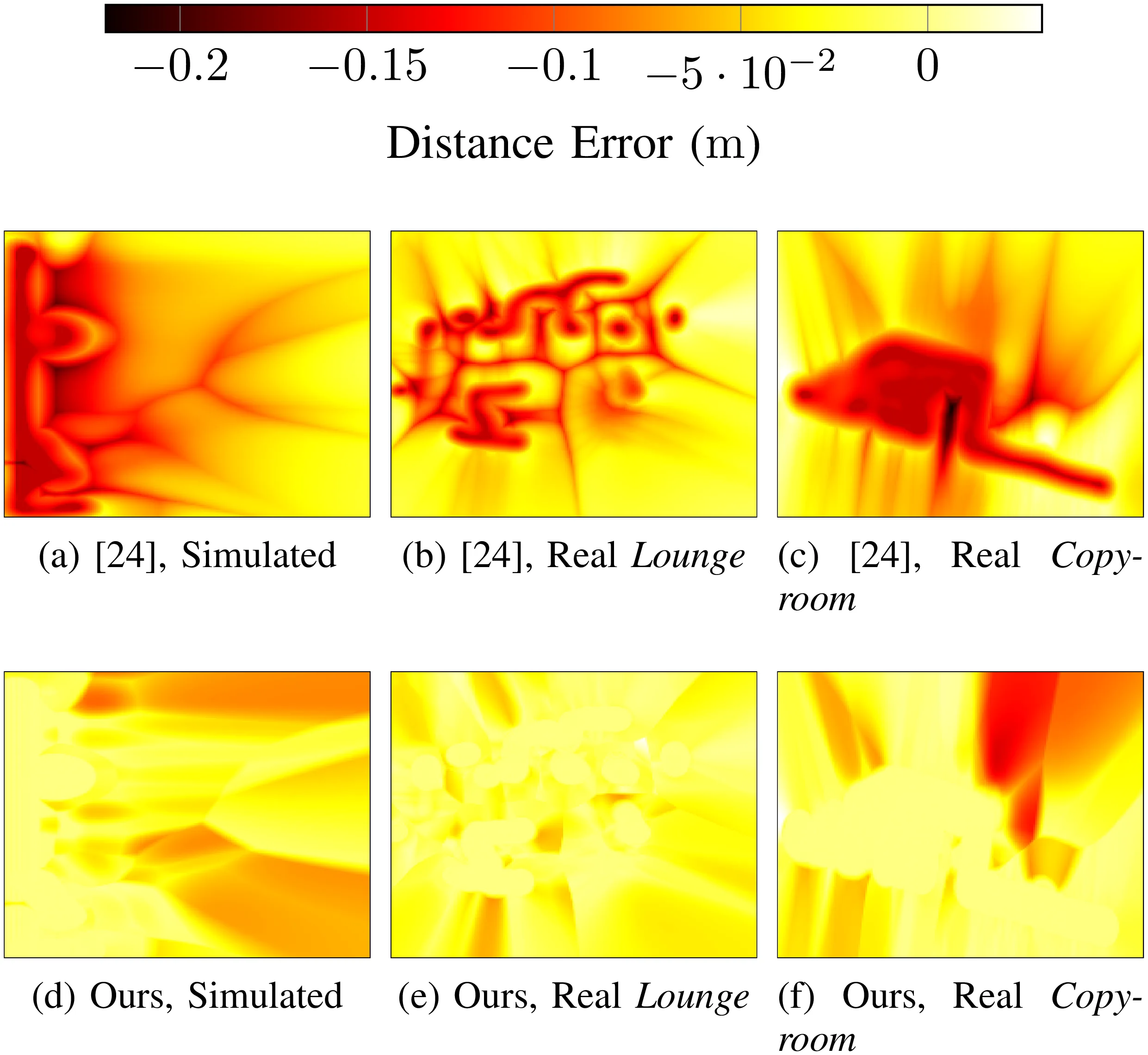
Estimation Error Heatmaps Distance field estimation error heatmaps for the baseline and proposed approaches. The proposed approach enables a lower estimation error compared to the baseline.
Collision Probability Fields
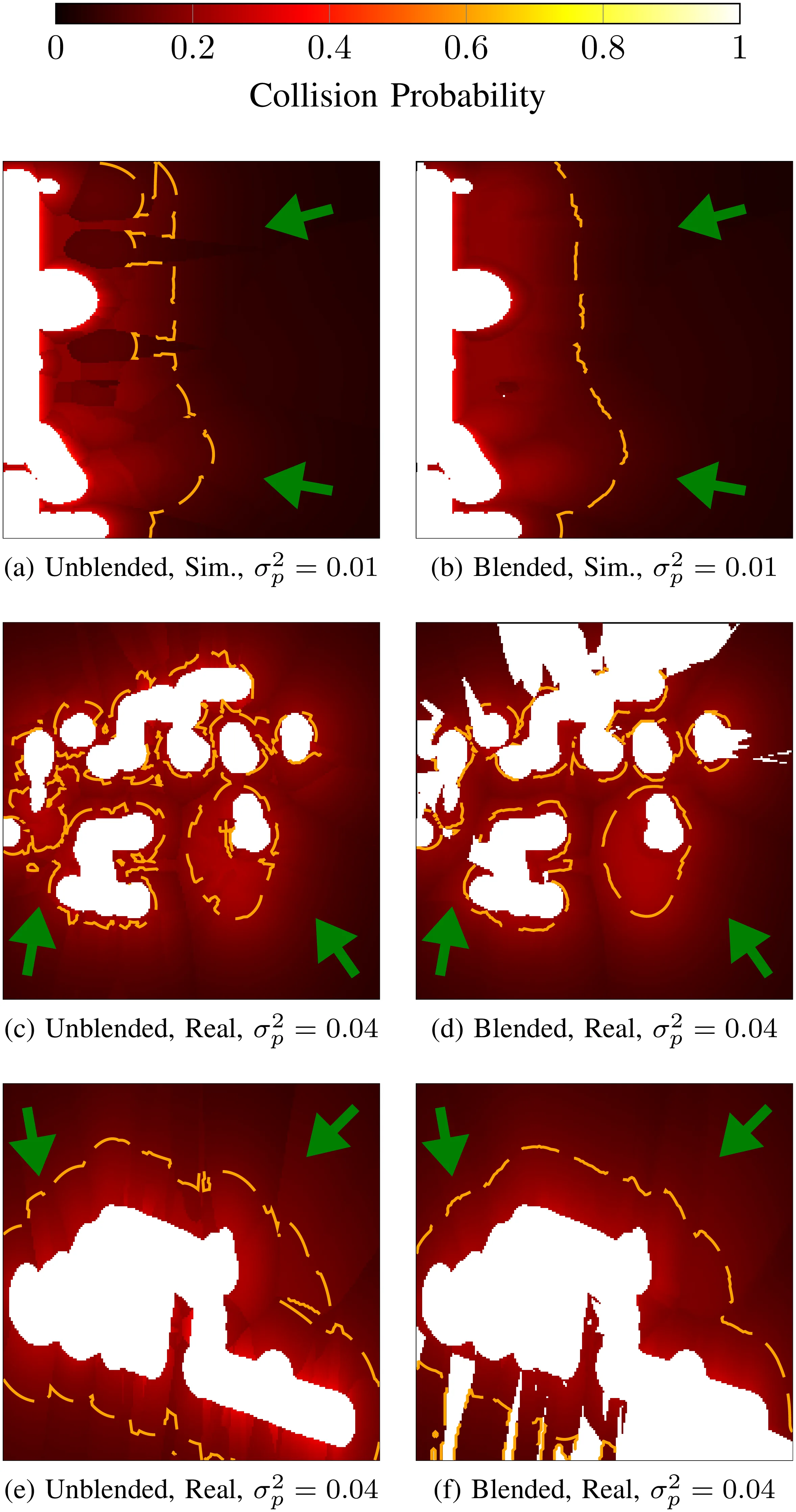
Collision Probability Fields Unblended and blended collision probability fields over 2D slices of 3D simulated and real-world point clouds. More noise in robot position is added to the real-world cases to simulate the effect of higher position uncertainty during real-world deployments. Dashed lines show 10% probability isocontours. Green arrows show the directions of camera frustums from which the surface point cloud data is collected. The blending approach produces smoother collision probability estimates while ignoring occluded regions.

Acknowledgments

This work was supported in part by an Uber Presidential Fellowship. This material is based upon work supported by, or in part by, the Army Research Laboratory and the Army Research Office under contract/grant number W911NF-25-2-0153. The authors thank J. Lee, M. Hansen, and D. Wettergreen for feedback on this manuscript.

BibTeX

@inproceedings{goel2025distance,
	title={Distance and Collision Probability Estimation from Gaussian Surface Models},
	author={Goel, Kshitij and Tabib, Wennie},
	journal={IEEE/RSJ International Conference on Intelligent Robots and Systems (IROS)},
	year={2025}
}